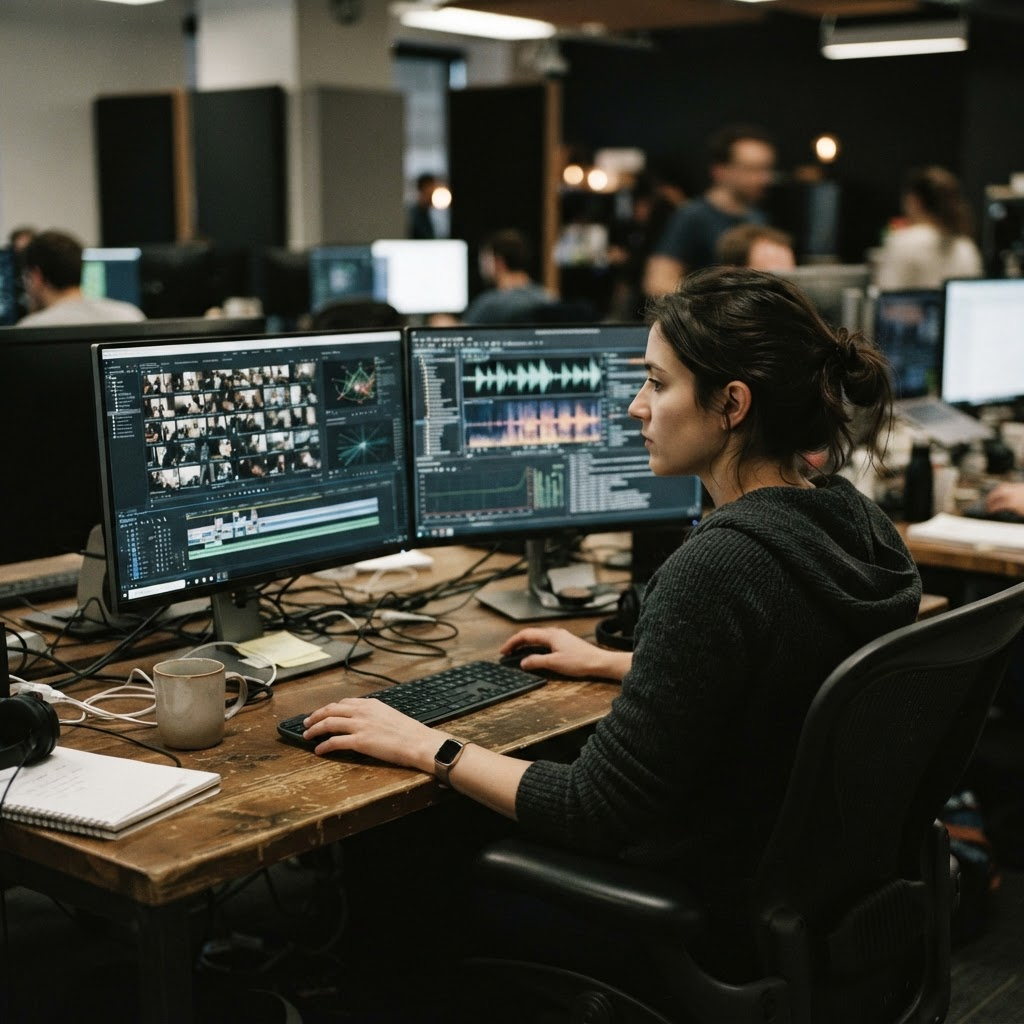
- What is egocentric video data for vision-language model training?
- First-person video recorded to a written spec and paired with language, so a model can learn how words relate to what the hands and objects in view are doing. On this site the language is a task instruction paired to each episode, alongside synchronized streams and action segments.
- Does Firsthand deliver captions or narration for egocentric video?
- Narration and dense captions are not stated as delivered. The one language field the site states is a task instruction paired to each episode, and step-level structure comes from action segments with a verb and a noun. If you need sentence-level descriptions, say so in the request and ask what the Spec Pilot would show.
- What is a task instruction paired to each episode?
- One language field per episode that says what the contributor was asked to do, attached on the same synchronized clock as the video and action stream. It describes the whole episode rather than each second, and its wording can be a fixed instruction set or freeform, decided in the spec.
- Are transcripts available?
- Transcripts are listed as an annotation option chosen in the spec, and audio is a spec decision rather than a default. Their format and coverage are not stated, so treat them as something to scope in the request. Speech in captured audio is scrubbed of names, addresses and card numbers.
- How is this different from a public narrated dataset?
- A public corpus gives you what its publisher recorded and annotated, with its own license. The Ego4D paper, for example, describes dense timestamped narrations over unscripted video. A custom collection gives you tasks, settings and streams you name, a per-episode instruction, and a buyer-owned license.
- Can I order only video and an instruction, without depth or IMU?
- Yes. Which streams and labels are included is set in the written spec before capture starts. A team that needs only video and an instruction can ask for exactly that, and a team that wants depth, IMU and hand pose can specify those too.
- How fast can a custom collection start?
- The site states a median of 48 hours from signed spec to first validated batch where coverage is deep, and three to four weeks where contributors have to be recruited first. That figure is for capture, not for any particular language-annotation scheme.
- Who owns the data, and in what formats is it delivered?
- The buyer. Delivery ships under a perpetual, non-exclusive, buyer-owned commercial license, in RLDS, LeRobot, WebDataset, or HDF5 and zarr, with consent, anonymization and provenance documentation.