For AI training

Custom data collection for AI training.

The same spec-first pipeline, pointed at whatever you are training. When the data that would fix your model's failure does not exist publicly, we collect it — to your specification, from paid and consented contributors, in the format your loader already expects.
Modalities
LLM · speech · vision · robotics
Reach
150+ countries
Splits
Train · fine-tune · eval
License
Buyer-owned
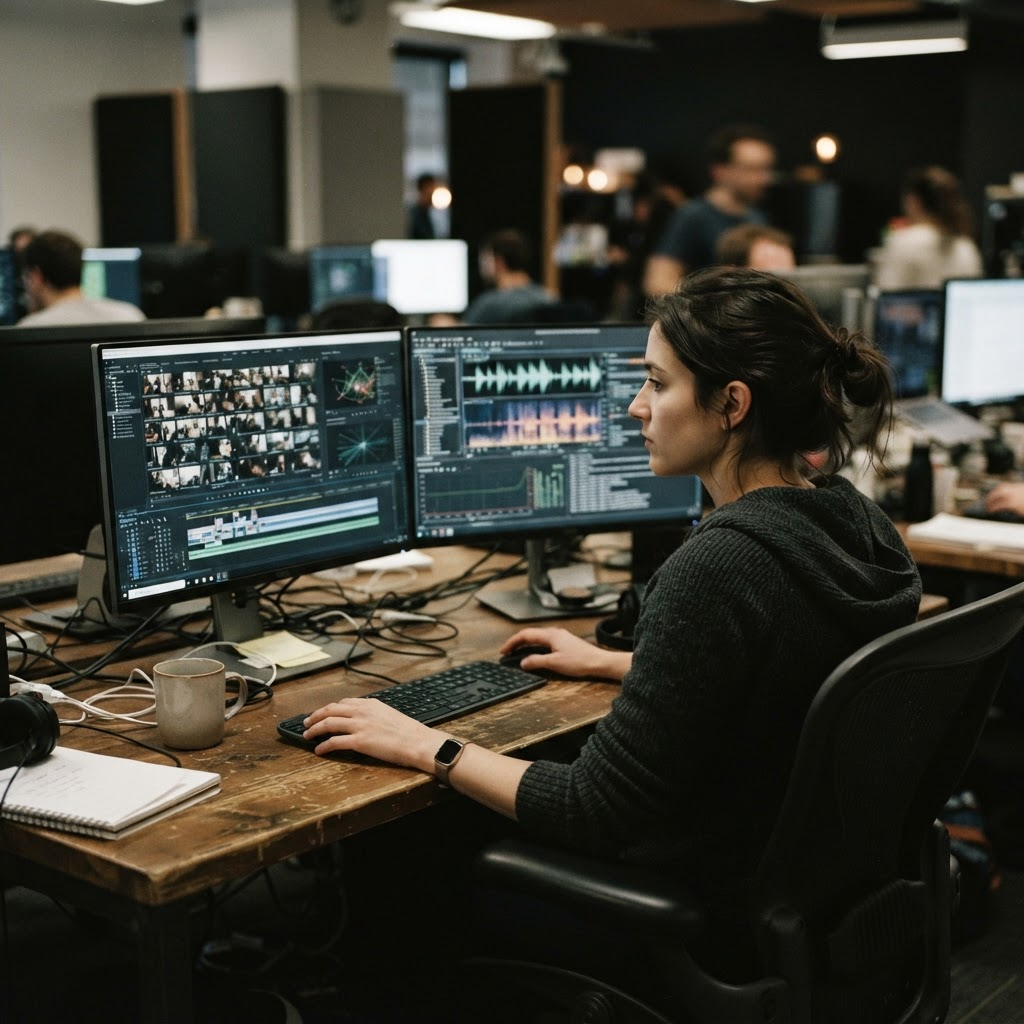
A data engineer reviews a grid of collected training data across two monitors, quality-checking a dataset.
One pipeline, every model type — the spec changes, the accountability does not.

What it is

Data built for your model, not someone else's.

End-to-end custom data collection is a managed service that takes an AI data need from problem to owned dataset in a single accountable pipeline — discovery, spec, sourcing, capture, annotation, QA, and licensed delivery — so you brief one team instead of stitching together crowds, tools, and reviewers yourself.

By model type

What we collect, and why.

Custom collection is not one product — it is the same accountable pipeline aimed at the specific gap in your system. The common cases, with an example brief for each:

LLMs & assistants

The gap — Instruction, preference, and domain data in the languages and registers scraped text underserves.

We collect — Prompt/response pairs, preference rankings, multi-turn dialogue, and expert-written domain answers.

Example brief — A support assistant that keeps failing in Brazilian Portuguese and clinical terminology.

Speech & ASR

The gap — Real speakers in the accents, languages, and acoustic channels your users actually call from.

We collect — Scripted and spontaneous speech, wake words, and command sets, transcribed and timestamped.

Example brief — A voice product that mishears second-language English on far-field, in-car microphones.

Computer vision

The gap — Images of the exact objects, conditions, and long-tail cases your detector never sees enough of.

We collect — Labelled images and video across devices, lighting, angles, and deliberate hard negatives.

Example brief — A shelf-detection model that collapses on reflective packaging and low-stock gaps.

Embodied AI & robotics

The gap — Human demonstrations of manipulation, aligned across camera, depth, motion, and hand pose.

We collect — Synchronized egocentric video with hand pose and contact events, in RLDS and LeRobot.

Example brief — A manipulation policy that needs thousands of first-person tool-use demonstrations.

Multimodal models

The gap — Two or more streams from the same event, aligned on one clock — not merely in one folder.

We collect — Video + depth + audio + IMU + pose, hardware-synchronized and calibrated per session.

Example brief — A world model that has to learn how sound, motion, and vision relate in a kitchen.

Safety & evaluation

The gap — Fresh, uncontaminated, deliberately adversarial data your model has never seen in training.

We collect — Held-out evaluation sets, red-team prompts, and demographically balanced fairness slices.

Example brief — A benchmark you can trust because you know exactly how and when it was collected.

Every collection above runs through the same seven-stage pipeline — see it broken down on the end-to-end pipeline page.

FAQ

Custom collection for AI training, answered.

What is custom data collection for AI training?
It is building a training dataset to your specification rather than pulling one off a shelf — the exact modality, languages, demographics, devices, environments, and edge cases your model needs, collected by paid, consented contributors and delivered in your format under a buyer-owned license. It exists because the data that fixes a specific model failure usually does not exist publicly.
Which kinds of AI can you collect training data for?
LLMs and assistants, speech and ASR, computer vision, embodied AI and robotics, multimodal and sensor models, and safety or evaluation sets. Egocentric first-person video is our core specialism; every other modality runs through the same spec-first, consent-documented pipeline.
How is this different from a public or scraped dataset?
Public data answers a question someone else asked, carries unclear licensing, and may already be in your model. Custom collection answers your question, comes with signed consent and a perpetual commercial license, and — for evaluation — is fresh and uncontaminated because you know exactly when and how it was collected.
Can you collect for fine-tuning, RLHF, and evaluation, not just pre-training?
Yes. Instruction and preference data for fine-tuning and RLHF, held-out evaluation and red-team sets, and demographically balanced fairness slices are all common briefs. The spec stage pins down exactly which split each item belongs to so training and evaluation data never bleed together.
Tell us what your model keeps getting wrong.

Bring the failure — a language, a region, a condition, an edge case — and we will scope the collection that fixes it, with reach, timeline, and price before any commitment.