Both hands in frame, not one
Coordinated two-handed work asymmetric grasps, one hand stabilizing while the other manipulates needs both hands tracked through the whole sequence, not a single dominant-hand crop.
Manipulation
Requirements
Coordinated two-handed work asymmetric grasps, one hand stabilizing while the other manipulates needs both hands tracked through the whole sequence, not a single dominant-hand crop.
3D hand pose and contact events for each hand, aligned to the same clock as the video and depth, so a policy can learn when and how the two hands hand off.
When one hand occludes the other or the object, visibility flags mark it rather than letting a tracker hallucinate a pose.
A perpetual, buyer-owned commercial license backed by a documented consent chain, so a policy trained on the data can go into a product.
Why it matters
Most manipulation data defaults to a single-arm, single-camera setup because it is simpler to rig. But many real tasks, from opening a jar to folding fabric, depend on what the second hand is doing at the same instant: stabilizing, supporting, or handing off.
Capturing that requires two hands tracked simultaneously with per-hand visibility, not a wide shot that loses hand detail, and not a single wrist camera that only sees one side of the interaction.
Capture setup
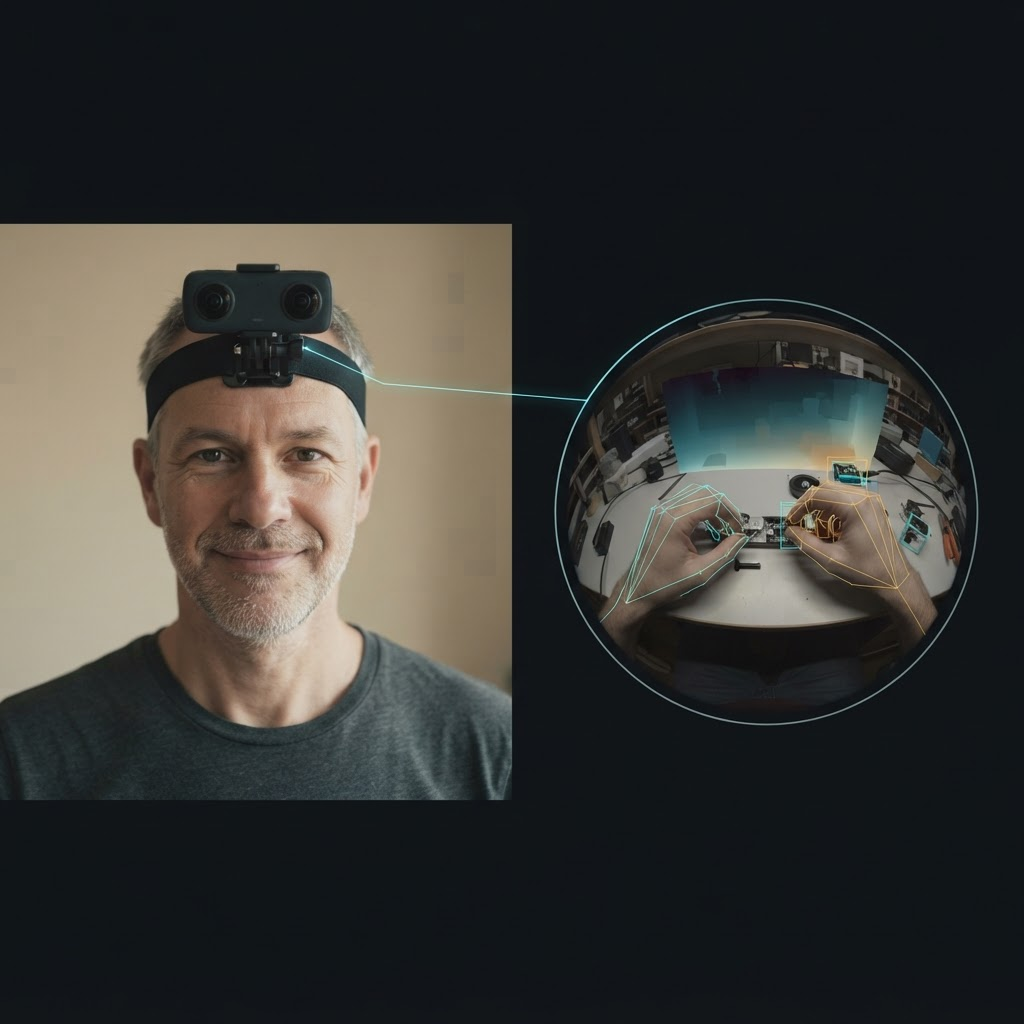
A head-mounted camera keeps both hands in frame from the viewpoint a two-handed policy will actually see from, entering frame from below through the reach-grasp-release cycle. Optional wrist cameras add close-range detail for fine manipulation on each hand.
3D hand pose is tracked per hand with visibility flags, and contact events mark exactly when and where each hand makes and breaks contact, all aligned to depth and video on one clock.
The spec
You describe the two-handed tasks your policy needs. We turn it into a written spec covering tasks, environments, regions, capture tier, annotation depth, and accept criteria, then quote reach, timeline, and price against that document before any capture begins.
The collection runs through the same seven-stage end-to-end custom collection pipeline as every Firsthand program: contributor recruiting, capture, per-batch QA, anonymization, and licensed delivery. Rejected items are recaptured at our cost.
Fast · on demand
Where coverage is already deep, the first validated batch lands in a median of 48 hours from signed spec. Thin environments typically take three to four weeks, because vetting operators there is the bottleneck, and we quote that timeline up front.
On-demand top-ups run against the same spec and accept criteria after each training run, so new bimanual data stays consistent with what you already hold.
Rights
Every custom collection ships under a perpetual, buyer-owned commercial license, and exclusivity is available so the data is never resold. Each episode links to a signed contributor release through a documented consent chain.
Faces, plates, and screens are detected and irreversibly blurred at ingest, and a reviewer confirms the result before anything ships. The anonymization record is delivered with the data.
Bimanual need vs delivery
| Bimanual manipulation need | What Firsthand captures |
|---|---|
| Both hands in frame | Head-mounted camera keeping both hands visible through the full task cycle |
| Per-hand pose | 3D hand pose tracked separately for each hand, with visibility flags for occlusion |
| Per-hand contact | Contact events for each hand, aligned to the same clock as video and depth |
| Fine manipulation detail | Optional wrist cameras for close-range detail on each hand |
| Depth | Synchronized depth stream for scene and contact geometry |
| Action structure | Instance segmentation, action segments, grasp and contact events |
| Quality | Measured against signed accept criteria; billed per validated hour; reject log with every batch |
| Formats | RLDS, LeRobot, WebDataset, plus HDF5, zarr, and Rerun .rrd |
Every collection runs through the same seven-stage end-to-end custom collection pipeline.
FAQ
Sources
Tell us the two-handed tasks your policy needs to perform. We will quote reach, timeline, and price against a written spec, with a first validated batch in a median of 48 hours where coverage is deep.