Commercial collection · Asia-Pacific
Egocentric Data Collection in South Korea
- Settings
- Commercial only
- Capture tier
- Phone in chest mount, up to full rig
- Legal basis
- PIPA
- Start
- Spec Pilot
Definition
What is commercial egocentric data collection in South Korea?
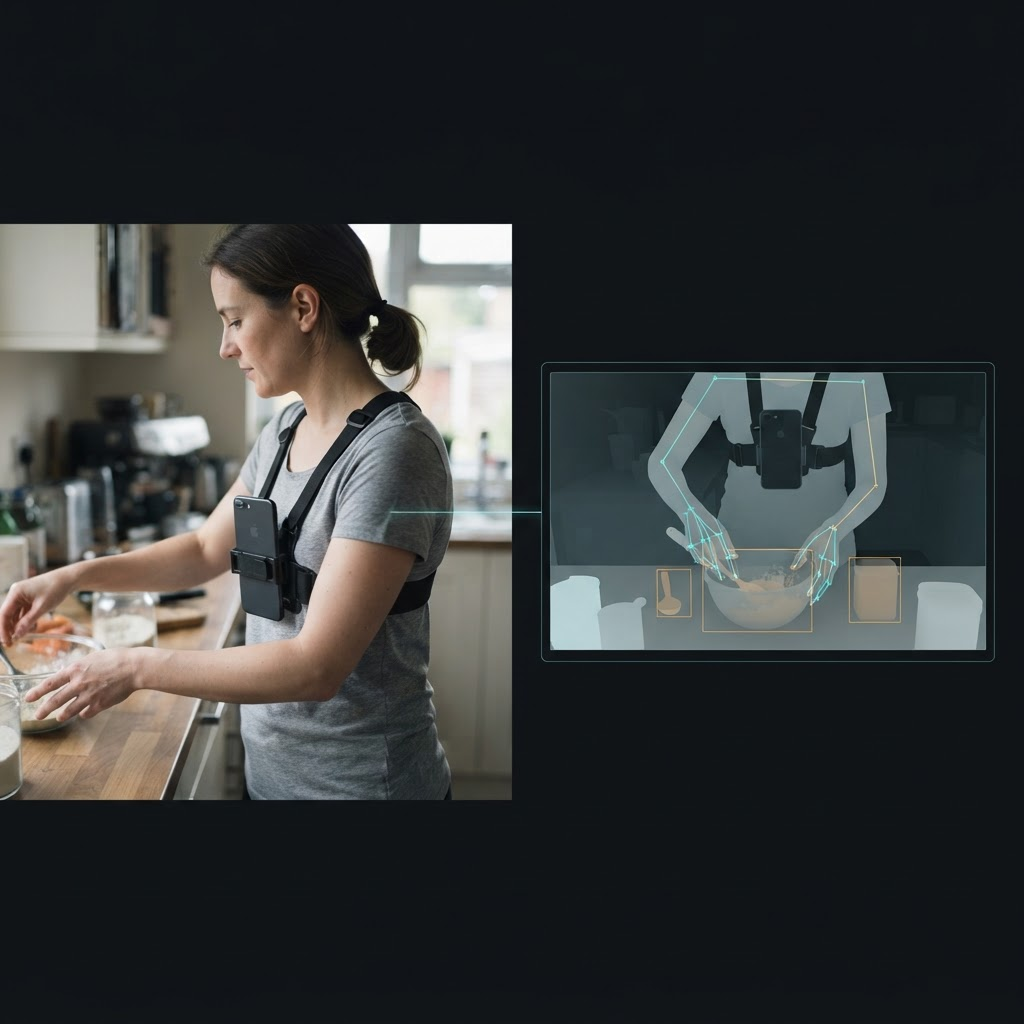
Egocentric data is video recorded from the point of view of the person doing the work, with their hands, tools and the objects they handle in frame. Commercial egocentric data collection narrows that to paid, real-world work settings: the shelves, stockrooms, service bays, commercial kitchens and workbenches where the tasks an embodied AI or robotics model has to learn actually happen.
In South Korea, Firsthand runs this as custom collection. You write down what the model is missing, which tasks, which environments, which conditions and how deep the annotation goes, and contributors in South Korea are recruited to capture exactly that, in the commercial settings the spec names.
Geography is a diversity axis in its own right. Packaging, tools, store layouts and work habits differ from market to market, and a model trained on one country's footage quietly overfits to it. Adding South Korea to a spec is how a program widens that spread on purpose instead of collapsing onto whoever was easiest to recruit.
Status for South Korea: Legal basis on file. See every country in the program.
Coverage data
What is already on file for South Korea?
South Korea is one of the jurisdictions with depth in Firsthand's published coverage data: a named legal basis (PIPA) is on file, and one commercial environment is already listed for it.
Listed environments are where a spec can usually start fastest. Other commercial environments are still recruited to spec when a program asks for them.
- Retail & shelf ops
Shelf stocking, facing and store-floor tasks, recorded first-person with the hands in frame.
Commercial settings
Which commercial settings can be recorded?
Only commercial environments are in scope. Each row links to the dataset page for that environment; the last column shows whether South Korea is already listed for it in the coverage data.
| Environment | What is recorded | Coverage in South Korea |
|---|---|---|
| Retail & shelf ops | Shelf stocking, facing and store-floor tasks, recorded first-person with the hands in frame. | Listed for South Korea |
| Warehouse & logistics | Picking, packing and handling work, recorded first-person with the hands in frame. | Recruited to spec |
| Kitchen & food prep | Commercial kitchen and food-prep work only under this program, not home kitchens. | Recruited to spec |
| Automotive service | Service-bay tasks, recorded first-person with the hands and tools in frame. | Recruited to spec |
| Tool use & assembly | Hand-tool and assembly procedures, recorded first-person with the hands and tools in frame. | Recruited to spec |
"Listed" means the environment already appears for South Koreain the published coverage data. "Recruited to spec" means contributors are sourced for that environment when a spec asks for it; pool sizes are quoted per engagement rather than published.
Household chores and home routines are excluded from this program. If your model needs home footage, see everyday routine collection instead.
Capture
Which device do contributors record on?
The default tier for commercial collection in South Koreais a recent-generation smartphone worn in a chest mount. It keeps both hands free and in frame, it is quick to deploy on a shop floor, and it records the task from roughly where the worker's eyes are. The project sets the minimum device spec, and contributors whose device does not meet it are not admitted to that project.
When a spec needs more than phone video, the same program can step up a tier: a 360 head mount for wider context, or the full instrumented rig with a head-mounted camera, dual wrist cameras, depth and IMU, synchronized to a shared clock. Same spec, same QA bar, whichever tier the project uses.
See egocentric video data collection for how the tiers compare, and sample data outputs for the files a recording ships with.
Consent
How are consent and the legal basis handled in South Korea?
South Korea is one of the jurisdictions whose consent framework is already documented in Firsthand's provenance section, so a named legal basis can be printed: PIPA. The official regulator or statute page is linked in the sources below.
Releases are collected before capture, and contributors stop recording when an un-consented person enters the manipulation region. Every hour ships with its consent record, so the provenance of a clip can be traced back to a signed release.
A documented basis is a starting point, not a substitute for the engagement paperwork: environment access and site permission are still confirmed for every location a contributor proposes.
Read the full chain of custody on the provenance page.
Privacy
How is footage anonymized?
Commercial settings put bystanders, customers, vehicles and screens in frame far more often than a home does. Every clip runs through the anonymization pipeline before delivery: faces, licence plates and screens are detected, tracked across frames, redacted and then checked in a human review step.
Detection works on bounding boxes, so what gets blurred is auditable rather than a black box. The method is documented on the anonymization page.
QA
How is footage checked before delivery?
| Gate | What is checked | If it fails |
|---|---|---|
| Spec fit | The take shows the task, environment and conditions the spec asked for | Rejected and recaptured |
| Consent | A signed release exists for every person in the manipulation region | Rejected; never shipped |
| Sync | Streams are present and aligned to the shared clock (rig tier) | Rejected and recaptured |
| Anonymization | Faces, plates and screens redacted and human-reviewed | Held until redaction passes |
| Billing | Only validated hours are invoiced | Rejected hours are never billed |
Rejected episodes, recaptures, calibration time and travel are never billed. You pay per validated hour: footage that passed sync and QA against your spec.
Delivery
What is delivered, and in which formats?
Footage from South Korea is delivered in the same formats as every other Firsthand program: RLDS, LeRobot, WebDataset, HDF5, zarr and Rerun .rrd, each mapped to the canonical episode schema. Annotation depth, from action segments to hand pose, is whatever the spec asked for.
Data ships under a buyer-owned commercial licence. See delivery formats for the schema and pricing for how a quote is built.
Start
How do you start a collection?
- 01 · Brief the gapTell us the tasks, commercial settings and conditions you need from South Korea.
- 02 · Approve the specTasks, environments, region, capture tier, annotation depth and accept criteria, quoted for reach, timeline and price.
- 03 · Run a Spec PilotA small, fast first batch that proves the spec and QA bar hold on real footage before volume scales.
- 04 · ScaleThe same pipeline scales to the size the program needs, with on-demand top-ups afterward.
A median of 48 hours from signed spec to first validated batch where coverage is deep.
Asia-Pacific
Which nearby countries are covered?
Multi-country specs are normal. These are the other Asia-Pacific countries in the commercial program.
| Country | Status | Legal basis | Listed environments |
|---|---|---|---|
| South Korea (this page) | Legal basis on file | PIPA | Retail & shelf ops |
| Australia | Listed capture country | Confirmed per engagement | Recruited to spec |
| Japan | Legal basis on file | APPI | Kitchen & food prep, Retail & shelf ops, Tool use & assembly |
| New Zealand | Recruited to spec | Confirmed per engagement | Recruited to spec |
| Singapore | Legal basis on file | PDPA | Retail & shelf ops, Warehouse & logistics |
| Taiwan | Recruited to spec | Confirmed per engagement | Recruited to spec |
| India | Listed capture country | Confirmed per engagement | Recruited to spec |
| Philippines | Listed capture country | Confirmed per engagement | Recruited to spec |
| Vietnam | Listed capture country | Confirmed per engagement | Recruited to spec |
See the Asia-Pacific collection page for multi-country specs across the region.
For collectors
Based in South Korea and want to contribute?
Contributors and partner collection teams can read the acceptance bar, consent handling rules and trial process on the for collectors page.
FAQ
Egocentric data collection in South Korea, answered.
- Can Firsthand collect egocentric data in South Korea?
- Yes. Recruiting runs worldwide, and contributors in South Korea are recruited to your written spec. South Korea has a legal basis already on file (PIPA).
- What does "commercial" collection mean here?
- Recordings are made in commercial settings only: retail floors, warehouses, commercial kitchens, automotive service bays and tool-use and assembly work. Household and home-routine footage is outside this program.
- Which device do contributors record on?
- The phone tier uses a recent-generation smartphone in a chest mount for hands-free first-person capture. The project sets the minimum device spec, and the capture tier can step up to a 360 head mount or the full instrumented rig when the spec needs it.
- How is privacy handled in the footage?
- Faces, licence plates and screens are detected and blurred in the anonymization pipeline, with a human review step, before footage is delivered.
- What formats is the data delivered in?
- RLDS, LeRobot, WebDataset, HDF5, zarr and Rerun .rrd, each with the same canonical episode schema.
- How much does collection in South Korea cost?
- Pricing is quoted per engagement rather than from a rate card, and billing is per validated hour: footage that passed sync and QA against your spec. See the pricing page for how quotes are built.
- How fast can a first batch arrive?
- A median of 48 hours from signed spec to first validated batch where coverage is deep. Where coverage is thin, the timeline is quoted against the spec before capture begins.
Sources
Where is the PIPA basis documented?
- Personal Information Protection Commission (PIPA) (opens in a new tab)The commission that administers the Personal Information Protection Act. www.pipc.go.kr
Need commercial footage from South Korea?
Tell us what your model is missing. We quote reach, timeline and price against a written spec, starting with a Spec Pilot.