Pretraining data

Dexterous Hand Pretraining Data

High-degree-of-freedom robot hands need a broad prior on how human hands move before they specialize to any one task. We collect that egocentric hand pretraining data on demand, to a written spec, with 3D hand pose and contact events synchronized across every stream.
Streams
Ten, synced under 2 ms
First batch
Median 48 h
Billing
Per validated hour
License
Buyer-owned
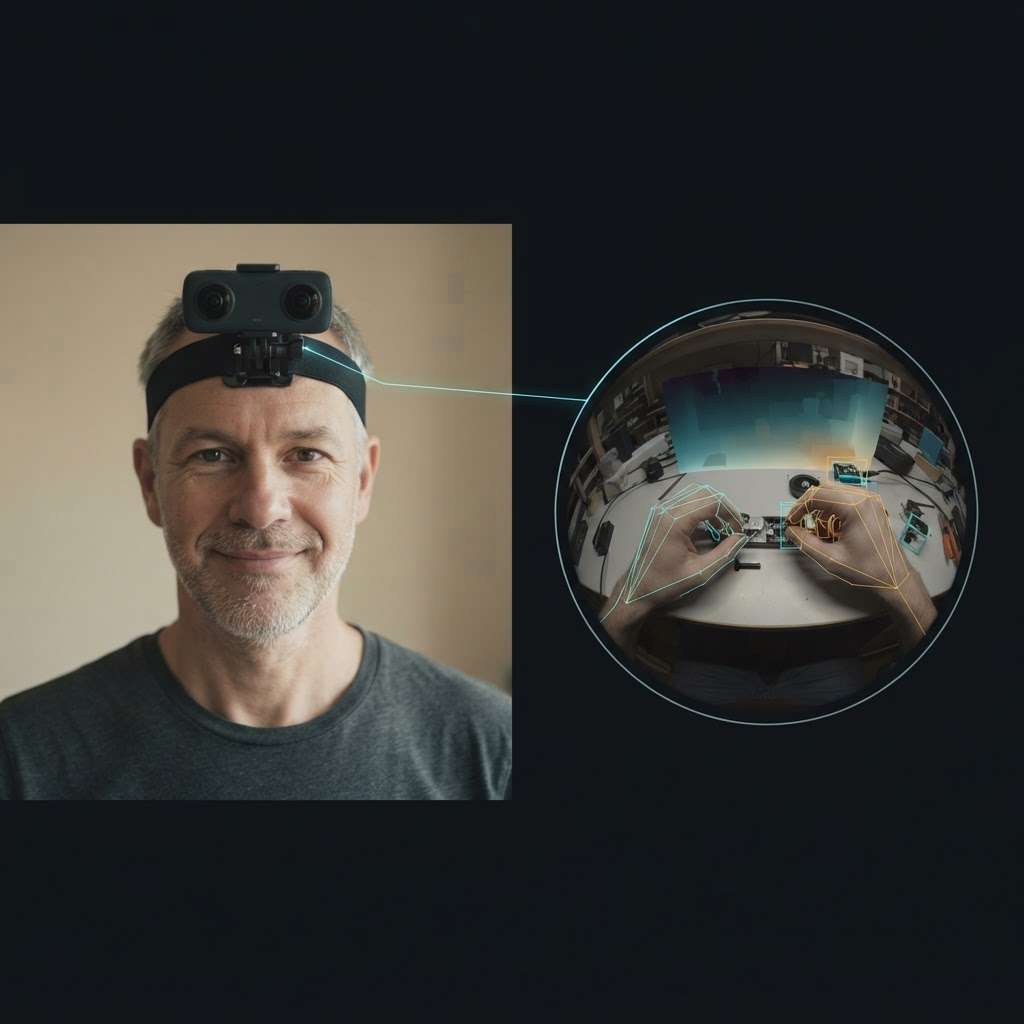
A contributor wearing a head-mounted camera beside a graphic of the first-person feed and hand-pose annotation layers it produces.
Egocentric capture keeps the hand in frame through the full reach-grasp-adjust cycle, the same signal a high-DoF hand foundation model pretrains on.

Requirements

What does hand pretraining data need that general pretraining data does not?

01

Finger-level pose, not just wrist position

A high-DoF hand has many more degrees of freedom than a gripper or wrist alone. Pretraining data has to carry 3D hand pose through the reach-grasp-adjust cycle, with visibility flags for occlusion, or it under-specifies exactly the signal a dexterous policy needs most.

02

Contact events aligned to the same clock

Grasp and release are defined by contact, not just proximity. Contact events need to share a hardware clock with video and depth so the fused signal is trustworthy across a large pretraining corpus, not just in a handful of clean clips.

03

Grasp and task diversity, not one grip repeated

A hand pretraining corpus is judged on how many distinct grasp types, objects, and task settings it spans, because that breadth is what a later, narrower mid-training or fine-tuning stage builds on.

04

Rights that clear a commercial run

Public egocentric hand-pose corpora often ship research-only. A pretraining program feeding a commercial hand foundation model needs a documented consent chain and a license that actually permits that use.

Definition

What is dexterous hand pretraining data?

Dexterous hand pretraining data sits at the base of a high-DoF robot hand foundation model’s training, the same role human video plays in NVIDIA’s GR00T N1 data pyramid: web data and human videos at the base because they are the most abundant and cheapest to capture at scale, synthetic data in the middle, and real robot trajectories at the top because they are the scarcest and most expensive.

For a dexterous hand specifically, that base layer is not generic egocentric footage — it is footage with 3D hand pose, contact events, and wrist trajectories carried through every frame, because those are the signals that let a foundation model learn how a hand actually manipulates objects, rather than just where it is in the scene.

Why human hands

Why do high-DoF robot hands need human hand data?

A high-degree-of-freedom robot hand has far more actuated joints than a parallel gripper, and teleoperating that many joints across enough tasks to build a broad prior is slow and expensive. Human hands already perform that full range of dexterous manipulation constantly, so egocentric human video is the layer that can realistically be captured at pretraining scale before a smaller, targeted robot-data stage follows it.

This mirrors why egocentric human capture became the pretraining source for robot foundation models generally: a person wearing a capture rig can move through far more grasp types, objects, and task settings per hour than a teleoperated robot hand can, at a fraction of the hardware cost.

Evidence

What did EgoScale show on a 22-DoF hand?

EgoScale reports a log-linear scaling law between the amount of human pretraining data and validation loss, a trend the paper states correlates with real-robot task performance downstream. On a 22-degree-of-freedom dexterous hand, the paper reports a 54% average improvement in success rate over training with no human pretraining at all.

That result comes from EgoScale’s full two-stage recipe, not human pretraining in isolation: a 20,854-hour pretraining corpus of action-labeled egocentric human video establishes the broad prior, and a lightweight, aligned mid-training stage — roughly 50 hours of human video plus about 4 hours of robot data across 344 tabletop tasks — carries that prior onto the 22-DoF hand where the 54% figure was measured.

Signals

What hand signals should pretraining data capture?

3D hand pose is the core signal: finger and wrist position tracked through the full reach-grasp-adjust cycle, with visibility flags so occlusion does not silently corrupt the label. Contact events mark exactly when a grasp or release happens, and wrist trajectories give the coarser motion path the hand followed to get there.

Video alone under-specifies what happened during a manipulation. Hand pose, contact events, and action segments turn raw footage into a signal a policy can actually learn a dexterous-manipulation prior from, the same distinction that separates a corpus useful for pretraining from one that is just a large pile of unlabeled clips.

Calibration and sync

How do calibration and sync make hand labels usable?

Manipulation-grade 3D hand pose is only as trustworthy as the calibration behind it. Camera intrinsics and extrinsics have to be measured and recorded per session so pose estimates are metrically accurate, not just visually plausible, and every stream — video, depth, hand pose, contact events — needs to share a single hardware clock so fused signals line up at the frame level.

When calibration or sync drifts across a large pretraining corpus, the error does not show up as an obvious visual glitch; it shows up as a hand-pose or contact label that is subtly wrong in exactly the way a scaling-law study would need to be right to hold. That is why sync and calibration checks run on every batch, not just spot-checked samples.

Diversity

How do you plan grasp and task diversity for hand pretraining?

A hand pretraining corpus is judged on breadth first: how many distinct grasp types (power grasps, precision pinches, in-hand reorientation), objects, and task settings it spans, because that breadth is what a later mid-training or fine-tuning stage builds on. A written spec sets that diversity target up front — which grasp families, which object classes, which environments — rather than letting volume alone stand in for coverage.

Generalist’s own framing from GEN-0 applies directly here: data quality and diversity matter more than sheer volume. A large pile of the same grasp repeated across similar objects adds hours without adding the coverage a dexterous policy actually needs.

Pretraining vs fine-tuning

Dexterous pretraining vs dexterous fine-tuning data: what is the difference?

Dexterous pretraining data is broad: many grasp types, objects, and settings, captured to build a general prior before a model is aligned to any specific hand or task. Dexterous fine-tuning (or mid-training) data is narrow: a smaller, closely scoped batch aligned to the target hand’s exact task set, captured on the same synchronized stream stack and accept criteria.

EgoScale’s recipe illustrates the ratio between the two: a pretraining corpus tens of thousands of hours deep is followed by a mid-training stage measured in dozens of hours, not thousands. Mid-training does not need to rival pretraining in scale; it needs to be closely matched to the target hand and camera geometry so the pretrained prior transfers cleanly.

This is the same overlap addressed on our general dexterous manipulation page: that page covers capturing fine-grained manipulation data for a specific policy’s task set, while this page covers the broader, pretraining-scale angle — building the general hand-manipulation prior a foundation model needs before any one task is specified.

What we collect

What does Firsthand collect for dexterous hand pretraining?

The same ten-stream capture stack used across every Firsthand program, scoped broadly for pretraining rather than to one task: 4K head camera, two wrist cameras, depth, IMU, 3D hand and body pose, instance segmentation, and action labels, hardware-aligned under 2 ms.

Coverage is set by a written spec across grasp types, objects, and environments, so a dexterous hand pretraining corpus can span the diversity a foundation model needs rather than one recorded location. Because hand pose, contact events, and action labels are captured live on the rig rather than estimated from raw video afterward, every episode carries the same manipulation-grade signal a mid-training or fine-tuning batch would, at pretraining scale.

Rights

What do licensing and consent look like for hand pretraining data?

Every custom collection ships under a perpetual, buyer-owned commercial license, with exclusivity available so the data is never resold, and each episode links to a signed contributor release through a documented consent chain — the piece many public hand-pose corpora do not clear for commercial use.

Faces, plates, and screens are detected and irreversibly blurred at ingest, and a reviewer confirms the result before anything ships. The anonymization record is delivered with the data.

Next step

How do you request a dexterous hand pretraining dataset?

Start with the grasp types, objects, and task settings your current corpus is missing, rather than a total hour target. That gap becomes a written spec — tasks, environments, capture tier, annotation depth, and accept criteria — quoted for reach, timeline, and price before any capture begins.

Many programs start with a Spec Pilot, a small, fast first batch that proves the spec and accept criteria before scaling volume. From there the collection runs through the same seven-stage pipeline as every Firsthand program, with on-demand top-ups available afterward as new gaps in coverage show up during training.

Hand signal vs delivery

What does dexterous hand pretraining need, signal by signal?

Dexterous hand pretraining data requirements and what a Firsthand custom collection delivers for each.
Hand pretraining needWhat Firsthand captures
Hand and object in frameHead-mounted camera keeping the hand and object visible through the full task cycle
Finger-level pose3D hand pose tracked through the sequence, with visibility flags for occlusion
Contact detailContact events aligned to the same clock as video and depth
Wrist trajectoryWrist and hand motion path tracked alongside finger-level pose
DepthSynchronized depth stream for scene and contact geometry
Grasp and task diversityCoverage set by a written spec across grasp types, objects, and environments
QualityMeasured against signed accept criteria; billed per validated hour; reject log with every batch
FormatsRLDS, LeRobot, WebDataset, plus HDF5, zarr, and Rerun .rrd

Every collection runs through the same seven-stage end-to-end custom collection pipeline.

Pretraining vs fine-tuning

Dexterous hand pretraining data vs dexterous fine-tuning data

How dexterous hand pretraining data compares with dexterous fine-tuning or mid-training data.
Pretraining dataFine-tuning / mid-training data
ScopeBroad: many grasp types, objects, and settingsNarrow: scoped to one target hand and task family
PurposeBuild a general visual-motor priorAlign the pretrained prior to a specific hand and task
Typical scaleTens of thousands of hours (EgoScale: 20,854 h)Dozens of hours (EgoScale mid-training: ~50 h human + ~4 h robot)
Data sourceEgocentric human videoClosely aligned human and robot video
Capture stackSame ten synchronized streamsSame ten synchronized streams

FAQ

Dexterous hand pretraining data, answered.

What is dexterous hand pretraining data?
It is large-scale, first-person capture of human hands performing varied manipulation tasks, with 3D hand pose, contact events, and wrist trajectories synchronized to video and depth, used to train the general prior a high-DoF robot hand foundation model needs before task-specific alignment.
Why do high-DoF robot hands need human hand pretraining data specifically?
Teleoperating a high-degree-of-freedom hand across enough tasks to build a broad prior is slow and expensive. Human hands already perform that full range of dexterous manipulation, so egocentric human video is the layer that can realistically be captured at pretraining scale.
What did EgoScale report on a 22-DoF hand?
EgoScale reports a log-linear scaling law between human pretraining data scale and validation loss, and a 54% average success-rate improvement on a 22-degree-of-freedom dexterous hand when its 20,854-hour pretraining corpus is followed by a lightweight, aligned mid-training stage.
How is dexterous hand pretraining data different from general dexterous manipulation data?
Pretraining data is broad, spanning many grasp types, objects, and settings to build a general prior. Fine-tuning or mid-training data is a smaller, closely scoped batch aligned to one target hand and task family, captured on the same synchronized stream stack.
What hand signals matter most for pretraining?
3D hand pose through the reach-grasp-adjust cycle, contact events aligned to the same clock as video and depth, and wrist trajectories. Video alone under-specifies what happened during a manipulation.
How is custom dexterous hand pretraining data billed and delivered?
Per validated hour, quoted against your written spec before capture. Delivery is RLDS, LeRobot, WebDataset, HDF5, zarr, or Rerun .rrd, under a perpetual, buyer-owned commercial license.
Can we start with a small pilot before scaling a hand pretraining corpus?
Yes. A Spec Pilot is a small, fast first batch that proves the spec and accept criteria before you scale volume on demand.
Sources

Where are these dexterous hand pretraining claims documented?

Request a custom pretraining dataset.

Tell us the grasp types, objects, and task settings your hand foundation model needs to see. We will quote reach, timeline, and price against a written spec, with a first validated batch in a median of 48 hours where coverage is deep.