Collected on purpose, not scraped
Nothing is gathered speculatively. The target is agreed in a written spec before a single contributor is briefed, so every recording exists because a buyer asked for it.
First-party data
Why first-party matters
Nothing is gathered speculatively. The target is agreed in a written spec before a single contributor is briefed, so every recording exists because a buyer asked for it.
Recruiting, briefing, capture, upload, review, and delivery all run through our own contributor network and portal, so there is no unknown intermediary between the person recorded and the dataset you receive.
Every contributor signs a release granting the usage rights you need before collection begins, and you receive the consent artefacts with the batch rather than an assurance after the fact.
Contributors are paid hourly, including setup and retakes, not a bounty per item. A per-item rate optimises for volume and quietly wrecks quality.
Definition
In AI training, first-party data is data the provider collected itself. The provider recruited the contributors, briefed them on the task, paid them, holds their signed releases, and ran the review that decided what ships. The opposite is third-party data: footage scraped from the web, bought from an aggregator, or relicensed from a collection someone else built for a different purpose.
The distinction matters because a training dataset inherits every gap in its history. If nobody can say who recorded a clip, what they agreed to, or why it was accepted, those questions do not disappear when the clip enters a training run. They resurface later, during a licensing review or a customer’s procurement process, when they are much harder to answer.
Our network
Firsthand runs a distributed contributor network with a web portal for assignment, upload, and review. A buyer’s written spec is turned into assignments; contributors are briefed and capture against it; uploads come back through the same portal and are reviewed before anything is accepted.
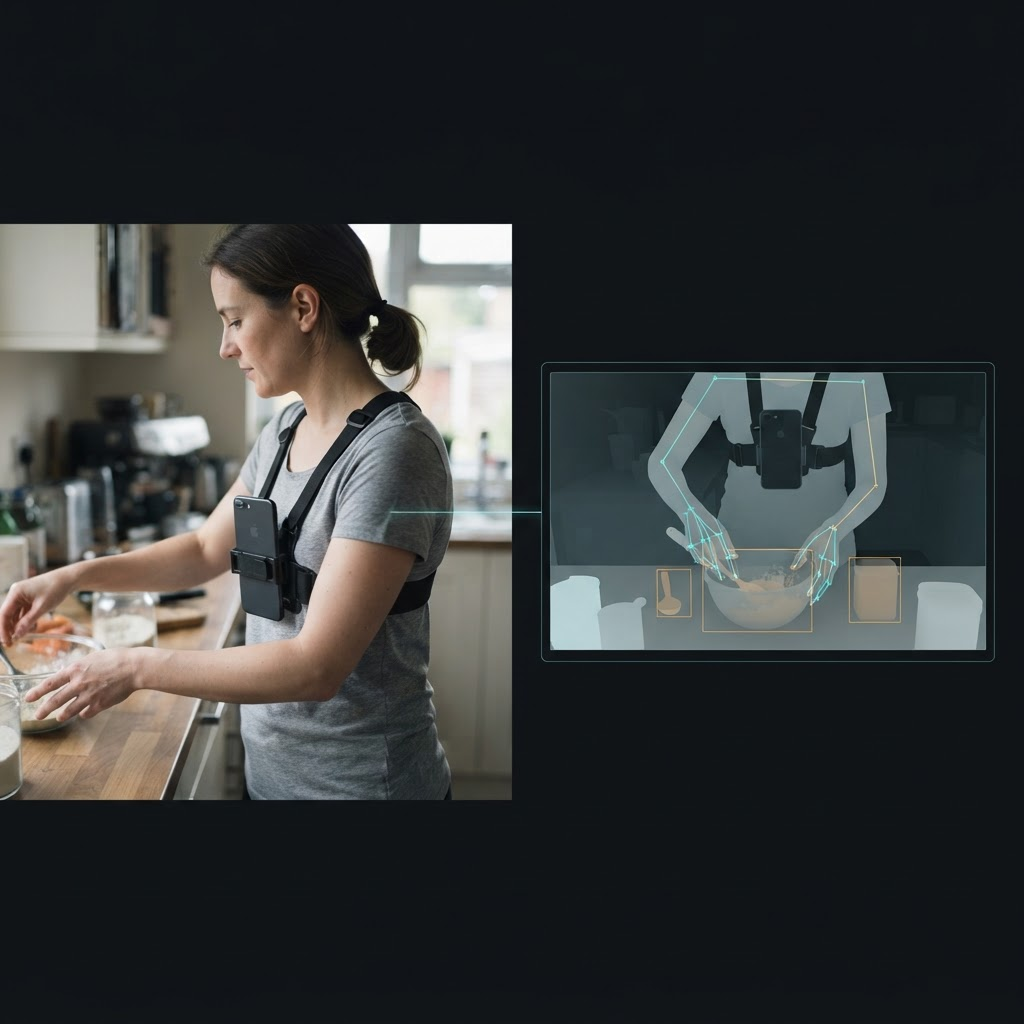
Contributors are briefed, paid hourly, and collected against the spec, with a specialized rig such as our synchronized egocentric hardware where the project needs it. People who want to capture for the network can apply on the for-collectors page, which publishes the release they would be signing.
Consent and pay
Every contributor signs a participant release before capture. The release is published verbatim on the provenance page, together with the de-identification steps applied to every clip, so a buyer can read exactly what each person agreed to.
Contributors are paid the hourly rate stated in their schedule for all time spent in session, including setup, calibration, and breaks. Payment is not contingent on recordings being accepted, delivered, or licensed, and there is no per-task bounty and no rejection clawback. The current rates are listed on the provenance page.
Quality
Every recording is human-reviewed before delivery for task match, visible hands, and the absence of staged or idle footage. Uploads missing camera telemetry are rejected automatically, before a reviewer sees them.
If an item cannot meet the spec, or a bystander cannot be de-identified, it is dropped rather than shipped at a discount to pad the count. You see the reject reasons in a reject log, not just the accepted items.
Privacy
Faces, licence plates, and screens are detected and irreversibly blurred at ingest, then confirmed by a reviewer before anything ships. Speech is scrubbed of names, addresses, and card numbers while ambient audio is retained.
If a person in frame cannot be de-identified, the clip is discarded rather than shipped. Files are organised in a human-readable, PII-free layout of project, category, activity, slot, and version.
Licence
You receive a perpetual, irrevocable, worldwide, buyer-owned licence that is non-exclusive by default, with a data card recording the jurisdictions of capture and the consent basis. Exclusivity, where a program needs it, is a separate term to negotiate.
Because the data was collected first-party, the licence is backed by releases Firsthand itself holds rather than by a chain of onward licences. These are the general terms stated on this site’s provenance and terms pages, not legal advice for a specific contract.
Getting started
Where coverage for the requested tasks and regions is already deep, the median time from signed spec to first validated batch is a median of 48 hours. Where it is thin, turnaround runs three to four weeks while recruiting expands in parallel across more regions.
Most orders begin with a Spec Pilot: a small, fast first batch that proves the spec and accept criteria hold up on real footage before you commit to volume.
At a glance
Every collection runs through the same seven-stage end-to-end custom collection pipeline. End-to-end custom data collection is a managed service that takes an AI data need from problem to owned dataset in a single accountable pipeline.
Comparison
| Attribute | Scraped or resold third-party data | First-party collection (Firsthand) |
|---|---|---|
| Who recorded it | Often unknown | A briefed contributor in our own network |
| Why it exists | Collected for another purpose | Collected to your written spec |
| Consent | Varies; often not documented | Signed release per contributor, delivered with the batch |
| Contributor pay | Not applicable or unknown | Hourly, not contingent on acceptance |
| Review | Varies | Human review of every recording, plus a reject log |
| Anonymization | Varies | Faces, plates, and screens blurred and reviewer-confirmed |
| Licence | Depends on the onward licence chain | Buyer-owned, perpetual, non-exclusive by default |
Chain of custody
| Step | What happens | What you receive |
|---|---|---|
| Spec | Target tasks, environments, and streams agreed in writing | The written spec and accept criteria |
| Briefing and consent | Contributors are briefed and sign a release before capture | Consent records with the batch |
| Capture and upload | Assignments run through the contributor portal | Per-recording metadata |
| Review | Automated telemetry check, then human review | Reject log with reasons |
| De-identification | Faces, plates, and screens blurred; unresolvable clips discarded | Anonymized footage |
| Delivery | Accepted recordings packaged for your pipeline | Data card and buyer-owned licence |
FAQ
Tell us the tasks, environments, and streams you need. We will quote reach, timeline, and price against a written spec and collect it through our own contributor network.