Un-consented people are the target, not your signal
The consented operator, their hands, and their point of view are untouched. Anonymization removes bystanders, plates, and screens that would re-identify someone who never signed a release.
Privacy-safe capture
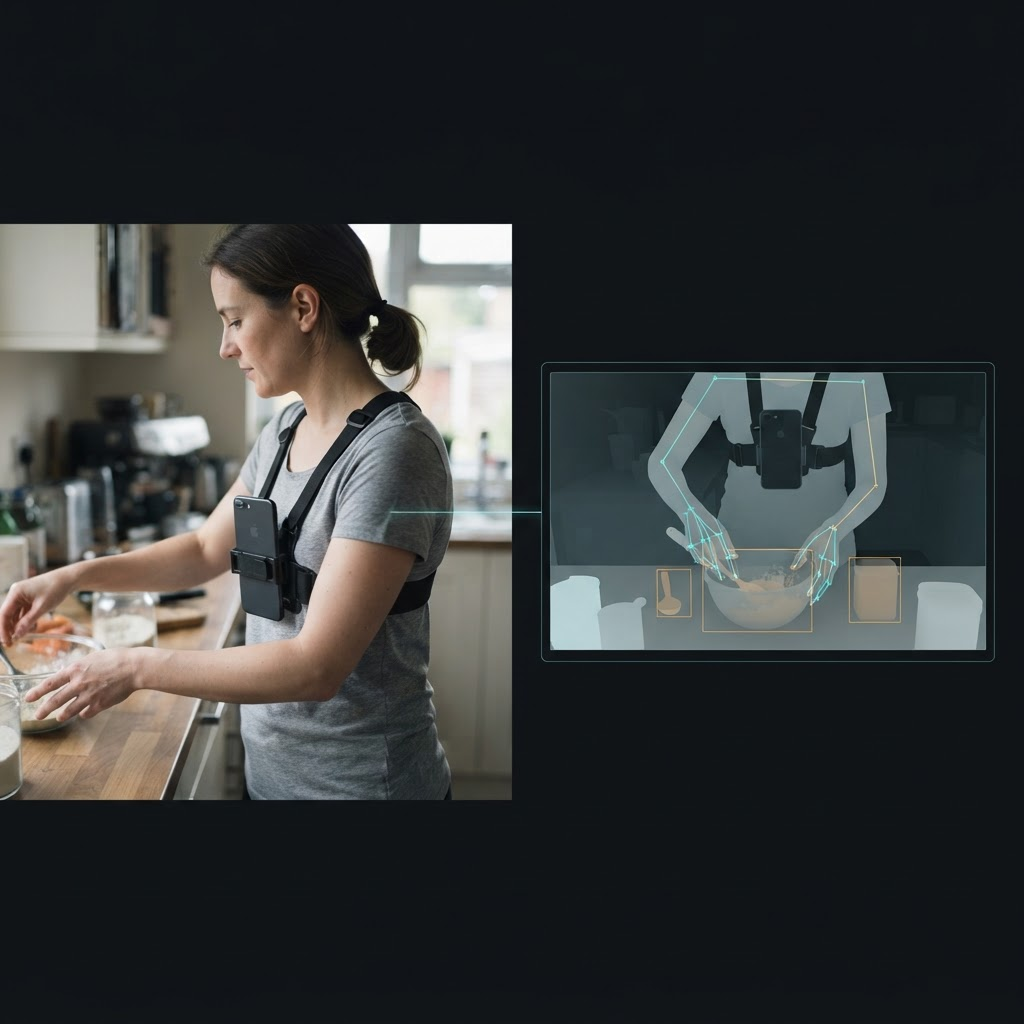
What anonymization covers
The consented operator, their hands, and their point of view are untouched. Anonymization removes bystanders, plates, and screens that would re-identify someone who never signed a release.
Blur is baked into the delivered pixel data. There is no un-blurred master shipped alongside the dataset and no metadata toggle that restores the original region.
An automatic detector flags faces, plates, and screens on every frame, but a human reviewer scrubs the episode and confirms no un-consented person is identifiable before it is cleared for delivery.
The detector version, pass timestamp, and reviewer confirmation are recorded in the batch data card, so the anonymization claim is checkable against any specific file rather than asserted for the batch as a whole.
Definition
Anonymized egocentric video data is first-person footage where the identifiers of un-consented people have been removed before delivery: faces and heads, licence plates, legible screens and documents, and spoken names, addresses, or numbers in the audio track. It is distinct from footage that simply happens not to show bystanders — anonymization is an active detection, redaction, and review pass applied to real-world captures that otherwise would.
On this site, this pass is part of every custom egocentric collection, not a separate product. Every episode delivered under a custom order has already gone through detection, redaction, and human review before it reaches the buyer.
Why it matters
Egocentric capture happens in real environments — kitchens, warehouses, streets, workplaces — where people other than the consented contributor appear incidentally: a coworker in the background, a passerby, a licence plate through a window. Training or shipping a commercial model on footage that includes identifiable, un-consented people carries a privacy exposure that anonymization is designed to remove.
Because the signal embodied AI and robot-learning models need is in the hands, objects, gaze, and scene, removing bystander faces does not remove the training signal. The consented operator and their point of view stay fully intact.
What gets anonymized
Four categories are covered on every episode: faces and heads, including bystanders, reflections, and partially occluded or profile faces, not just forward-facing detections; licence plates visible through windows, doorways, or in outdoor and automotive captures; screens and documents such as phone and monitor content, forms, badges, and mail that would leak names, addresses, or account data; and spoken identifiers, where names, addresses, and numbers in any audio track are scrubbed from the transcript and muted in the waveform.
The consented operator and anyone who has signed a release are exempt from blurring — anonymization targets un-consented third parties, not the contributor whose task is the point of the capture.
Pipeline
A vision model runs on every frame at ingest, flagging faces, heads, licence plates, and any legible screen or document, and detections are linked across frames so a face that turns away, blurs in motion, or leaves and re-enters stays covered for the whole clip. Each flagged region is then irreversibly blurred in the pixel data, not masked with metadata a downstream user could switch off.
A human reviewer scrubs the episode and confirms no un-consented person is identifiable in any frame before it is cleared. If the reviewer is unsure a region is fully covered, the episode is held or discarded rather than downgraded and shipped. The detection pass and reviewer sign-off are then recorded against the episode ID in the batch data card.
Consent and provenance
Every contributor signs a documented release before capture, and that consent chain is part of what ships with the data rather than a claim made separately from the footage. Anonymization and consent are complementary, not substitutes for each other: consent governs the contributor whose task is being filmed, while anonymization protects the un-consented bystanders who appear incidentally.
A custom order also ships under the license terms stated on this site’s provenance and terms pages: a perpetual, irrevocable, worldwide grant that is non-exclusive by default, with the buyer owning the resulting data.
Delivery
A buyer receives egocentric video where every episode has already passed detection, redaction, and human review, delivered alongside the annotation layers the spec called for and a batch data card recording the detector version, pass timestamp, and reviewer confirmation per episode. There is no separate un-redacted master, and no step for the buyer to run anonymization themselves.
Formats match the rest of this site’s custom collections: RLDS, LeRobot, WebDataset, or MP4 with JSONL annotations, depending on what the spec calls for.
Guarantees
The pass is built around four guarantees. It is irreversible: the blur is applied to the pixel data of the delivered file, with no un-redacted master shipped alongside and no metadata key that reverses it. It exempts consented subjects: the operator and anyone who has signed a release stay in frame, because anonymization targets un-consented third parties, not the training signal the contributor was captured to produce.
It fails closed: if a reviewer is unsure a region is fully covered, the episode is held or discarded rather than downgraded and shipped anyway. And it is auditable: every episode carries the detector version, pass timestamp, and reviewer ID, so the anonymization claim for any specific file can be checked rather than taken on faith for the batch as a whole.
Data product vs. service
No, and the distinction matters when scoping a project. The video anonymization service anonymizes footage a customer already has and supplies to be processed. This page describes the data product: a custom egocentric video collection where anonymization is a built-in step of every delivered episode, not something a buyer sends footage through after the fact.
If the need is to de-identify existing footage already in hand, the video anonymization, face-blurring, or licence-plate-blurring services are the right fit. If the need is new first-person video of real tasks that has never been captured, a custom egocentric collection captures it already anonymized, consented, and licensed for commercial use in one order.
Getting started
Start with a written spec describing the tasks, environments, objects, and streams your model needs. Most orders begin with a Spec Pilot — a small, fast first batch that proves the spec and accept criteria, including the anonymization pass, hold up on real footage before scaling to the full order.
Where coverage for the requested tasks and regions is already deep, the median time from signed spec to first validated batch is 48 hours. Where it is thin, turnaround runs three to four weeks while recruiting expands in parallel across more regions.
At a glance
Every collection runs through the same seven-stage end-to-end custom collection pipeline. End-to-end custom data collection is a managed service that takes an AI data need from problem to owned dataset in a single accountable pipeline.
What gets anonymized
| Identifier type | How it is handled | Where it is documented |
|---|---|---|
| Faces & heads | Detected and irreversibly blurred, including profile and partially occluded faces; tracked across frames | /anonymization |
| Licence plates | Detected and irreversibly blurred, including plates visible through windows or doorways | /anonymization |
| Screens & documents | Phone, monitor, forms, badges, and mail content detected and blurred | /anonymization |
| Spoken identifiers | Names, addresses, and numbers scrubbed from transcript and muted in the waveform | /anonymization |
Pipeline
| Pipeline stage | What happens | Buyer-visible output |
|---|---|---|
| Capture | Contributor records the task to spec with the agreed camera tier | Raw egocentric footage (internal only) |
| Consent | Contributor signs a documented release before capture | Consent chain recorded in provenance |
| Anonymization | Vision model detects and irreversibly blurs faces, plates, and screens at ingest | De-identified pixel data; no un-blurred master |
| Human review | Reviewer scrubs the episode and confirms full coverage before clearance | Reviewer confirmation recorded per episode |
| Delivery | Annotated, anonymized episode packaged in the requested format | Batch data card with detector version and reviewer ID |
FAQ
Tell us the tasks, environments, and streams your model needs. Every episode passes detection, irreversible blurring, and human review before it ships, with a first validated batch in a median of 48 hours.