Documented, not assumed
Every contributor signs a written release before capture and has their identity verified. The release is published verbatim on the provenance page, so you can read exactly what was agreed.
Consent-backed capture
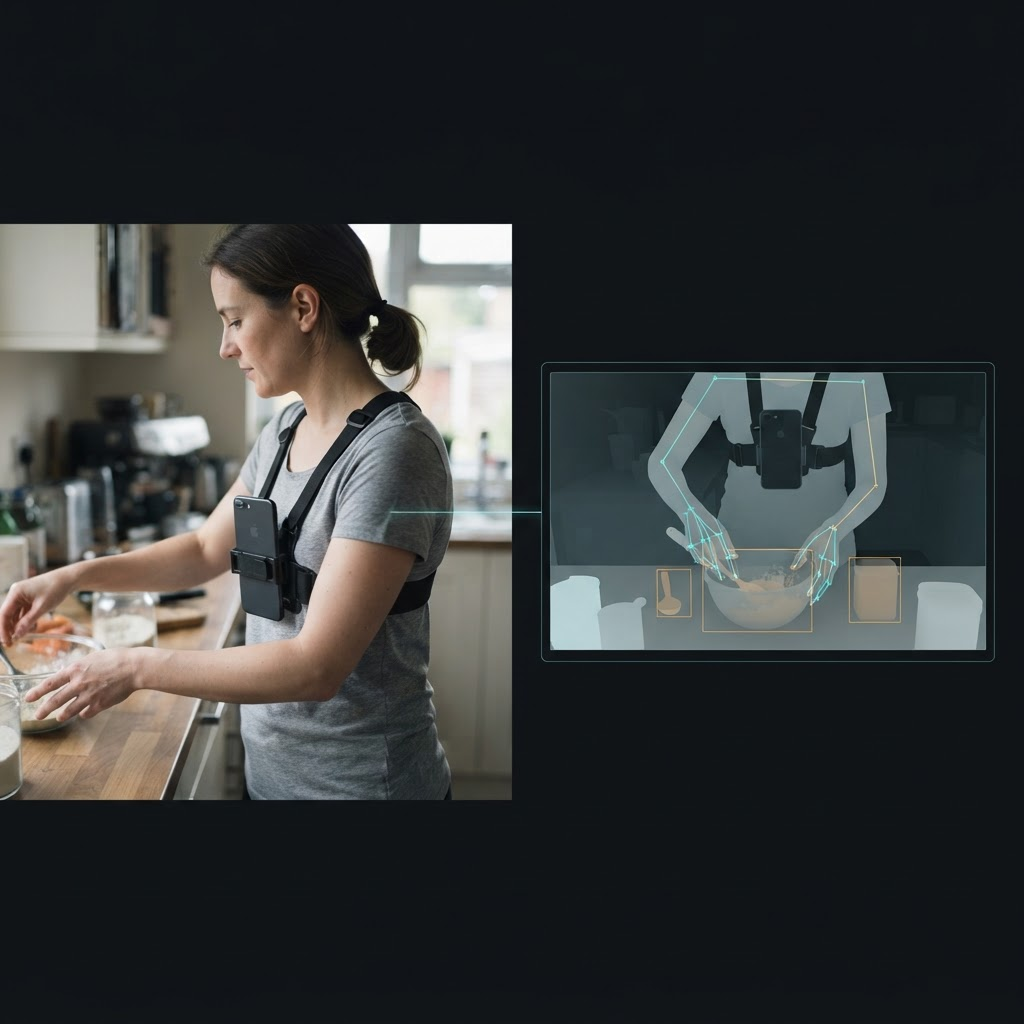
What consent-backed capture means
Every contributor signs a written release before capture and has their identity verified. The release is published verbatim on the provenance page, so you can read exactly what was agreed.
Consent artefact IDs are listed per episode in the batch data card, so a specific file can be checked against its release rather than the batch being vouched for as a whole.
People who have not signed are detected and blurred, and a human reviewer confirms none is identifiable. If someone cannot be de-identified, the footage is discarded rather than shipped.
Consent covers the people in the footage. The license covers what you can do with the data. You need both to be solid, and the two are documented separately.
Definition
Consented egocentric video data is first-person footage in which the people who recorded it, and anyone else it is allowed to show, agreed before capture, and where that agreement is documented rather than assumed. On this site every contributor signs a written release before capture, their identity is verified, and the release grants the commercial training rights a buyer needs.
The word that matters is documented. Many datasets say footage was gathered with permission without publishing what was signed or how it ties to individual files. A consented dataset, as this site uses the term, can be traced from a delivered episode back to a signed release through the consent artefact IDs listed per episode in the batch data card. That is different from a dataset that merely avoids obviously identifiable people.
It is also not the same as anonymized data or licensed data. Consent covers the people in the footage, anonymization removes un-consented bystanders from it, and the license defines what the buyer may do with the result. Most commercial buyers need all three. This page focuses on consent and on how it connects to the other two.
Participants
The contributor wearing the rig always signs a release before capture. That is the consent the whole chain starts from. Where the capture site needs it, site permission is kept on file, and where the site is semi-public, bystander signage is posted. Anyone else who happens to appear is a bystander who has not signed.
The release deals with bystanders in two ways. The contributor confirms they have not knowingly recorded any person who has not signed the release. And where an unidentified person does appear, the release states that Firsthand will de-identify them or discard the affected footage. Consented subjects, meaning the contributor and anyone else who signed, are not blurred. Un-consented third parties are.
The release also says what it does not grant. It gives no right to use a contributor’s name, likeness or voice for advertising or endorsement. The grant is for training, evaluating and deploying machine learning models, including commercial models, not for putting a contributor’s face in marketing.
Consent record
Consent on this site is a chain rather than a single signature: six checkpoints that run from before capture to after delivery. Any break at any checkpoint discards the footage instead of downgrading it, so a clip with a gap in its chain does not ship as a lower-grade clip.
What ties the chain to your files is the per-episode record. Consent artefact IDs are listed for each episode in the batch data card, so any specific file can be checked against its release. The first table below shows each checkpoint and what you can see of it as a buyer.
Detail beyond what the site already states, such as exactly which artefact types are attached to a given program, is set per program in the skill spec.
Bystanders
At ingest, automated detection finds faces, licence plates and screens, and speech is scrubbed of names, addresses and card numbers while ambient audio is kept. A human reviewer then confirms that no un-consented person is identifiable in any frame. Visible phone and monitor content is masked unless it is the object being manipulated, and participant faces are mostly out of frame by rig geometry.
Footage that cannot be de-identified is discarded rather than shipped. That is the practical meaning of a consent chain that fails closed: when the record or the redaction is not good enough, the clip does not reach you.
De-identification does not replace consent. It reduces the chance that an un-consented bystander is identifiable, but it does not stand in for a release from the people actually performing the recorded activity. The two are complementary, and the full pipeline is described on the anonymization page.
License
Consent and license answer different questions. Consent establishes that the people in the footage agreed to be recorded and to how the footage would be used. The license is the separate grant that defines what a buyer can do with the resulting dataset. A dataset can carry a permissive license and still have an undocumented consent problem underneath it, which is the risk a documented chain is built to close.
The release is what makes the buyer’s license possible. The contributor grants a perpetual, irrevocable, worldwide, sublicensable, royalty-free right to license the recordings to third parties for training, evaluating and deploying models, including commercial models. The grant extends to derivative representations such as depth maps, hand and body pose estimates, segmentation masks, textual action labels and model weights, so the annotation layers sit under the same consent as the video.
The buyer’s license, as stated on the provenance page, is perpetual, irrevocable and worldwide, non-exclusive by default, with the data buyer-owned. Training, evaluating, fine-tuning and deploying models, including commercial ones, is permitted. Derived weights are yours with no royalty, revenue share or reporting obligation. The footage itself cannot be redistributed, while models derived from it can. There is no expiry, and a lapsed program does not revoke data already delivered. Exclusivity is available per skill line or per environment as a separate term.
When you assess any public footage, check its own license. A Creative Commons Attribution-NonCommercial license, for example, does not permit commercial use of the material. This page summarises the site’s stated terms; the executed agreement controls and is sent before you sign, and it is not legal advice.
Collection and QA
Collection starts from your written skill spec. Paid contributors, briefed on the spec, perform the real task while wearing the capture rig. They are paid by the hour at a rate agreed in Schedule A, which covers setup, calibration and breaks. Payment is not contingent on recordings being accepted, delivered or licensed, and there is no per-task bounty.
Consent checks run alongside the rest of QA rather than after it. Detection and redaction happen at ingest, a human reviewer confirms every episode before clearance, and the detector version, pass timestamp and reviewer confirmation are recorded against the episode in the batch data card. If the reviewer is unsure a region is fully covered, the episode is held or discarded rather than downgraded and shipped.
Most orders begin with a Spec Pilot, a small, fast first batch that proves the spec and accept criteria hold up on real footage before the full order scales. Where coverage for your tasks and regions is deep, the median time from signed spec to first validated batch is 48 hours. Where it is thin, turnaround runs three to four weeks while recruiting expands. How many contributors, sites or regions a program covers is set per program in the skill spec.
Proof of consent
Each batch ships with the consent artefacts and a data card that lists jurisdictions of capture. The data card lists consent artefact IDs per episode, along with the detector version, pass timestamp and reviewer confirmation for the de-identification pass. That gives you a record you can spot-check against any individual file.
Before you buy, you can read the participant release verbatim on the provenance page, and the sample consent form is linked there. If your counsel needs the executed license text or a data card from a real batch before a call, ask and both will be sent.
The limits are stated up front. Withdrawal requests are honoured for undelivered footage, and contributors can withdraw from future sessions at any time. Delivered footage cannot be recalled from a licensee, and the release says so in terms, so the contributor has acknowledged it. For a buyer that means delivered data is stable, and for a contributor it means the limit was disclosed before they signed.
Getting started
Consent is part of every custom egocentric collection on this site, not an add-on you order separately. Start with a written spec describing the tasks, environments, objects and streams your model needs, and the format you want it delivered in.
We reply with reach, timeline and price against that spec. Anything the site does not already state, such as particular site-permission needs for your environments or the exact artefacts attached to your program, is set per program in the skill spec rather than assumed here.
At a glance
Every collection runs through the same seven-stage end-to-end custom collection pipeline. End-to-end custom data collection is a managed service that takes an AI data need from problem to owned dataset in a single accountable pipeline.
Consent chain
| Checkpoint | What is recorded | What you can see as a buyer |
|---|---|---|
| Before capture | Written release signed, identity verified, hourly rate agreed in Schedule A | Participant release on the provenance page; executed agreement sent before you sign |
| At capture | Site permission on file; bystander signage posted where the site is semi-public | Detail set per program in the skill spec |
| At ingest | Automated face, plate and screen detection; speech scrubbed of identifiers | Detector version and pass timestamp in the batch data card |
| At review | Human reviewer confirms no un-consented person is identifiable in any frame | Reviewer confirmation recorded per episode |
| At delivery | Consent artefact IDs listed per episode | The batch data card |
| After delivery | Withdrawal honoured for undelivered footage; delivered footage cannot be recalled | The limitation is written into the release |
The release
| Release clause | What it says | What it means for a buyer |
|---|---|---|
| Grant | Perpetual, irrevocable, worldwide, sublicensable, royalty-free right to license the recordings for training, evaluating and deploying models, including commercial models | The right to license commercially comes from each contributor’s own signature |
| Scope | Covers derivative representations: depth maps, hand and body pose estimates, segmentation masks, textual action labels and model weights | Annotation layers and derived weights sit under the same consent as the video |
| Compensation | Hourly rate in Schedule A for all time in session; not contingent on acceptance, delivery or licensing | Contributors are paid for time, not per accepted clip |
| Withdrawal | Future sessions at any time; deletion of undelivered recordings on written notice; delivered recordings cannot be recalled | Delivered data is stable; undelivered footage can be removed |
| Bystanders | No knowing recording of anyone who has not signed; unidentified people are de-identified or the footage is discarded | Un-consented people do not ship identifiable |
| No identity license | No right to use name, likeness or voice for advertising or endorsement | The footage is for model training, not marketing |
Comparison
| Attribute | Scraped or public footage | Consented custom collection (this site) |
|---|---|---|
| Per-person release | Varies; often not published or not available per file | Written release signed by every contributor before capture |
| Link from file to consent | Usually nothing you can check per file | Consent artefact IDs per episode in the batch data card |
| Commercial training rights | Check the source’s own license; non-commercial licenses do not permit commercial use | Release grants the right to license for commercial model training |
| Bystanders | Varies by source | Detected and blurred, human-reviewed, or footage discarded |
| Contributor pay | Not applicable or not stated | Paid hourly at a rate agreed in Schedule A |
| Delivered license | The source’s own terms | Perpetual, irrevocable, worldwide, buyer-owned, non-exclusive by default |
FAQ
Sources
Tell us the tasks, environments and streams your model needs. Every contributor signs a release before capture and every episode is tied to its consent record, with a first validated batch in a median of 48 hours where coverage is deep.