Scope set by the experiment
The lab writes the tasks, environments, label depth and accept criteria. A public release was scoped for someone else’s question before yours existed.
Research labs
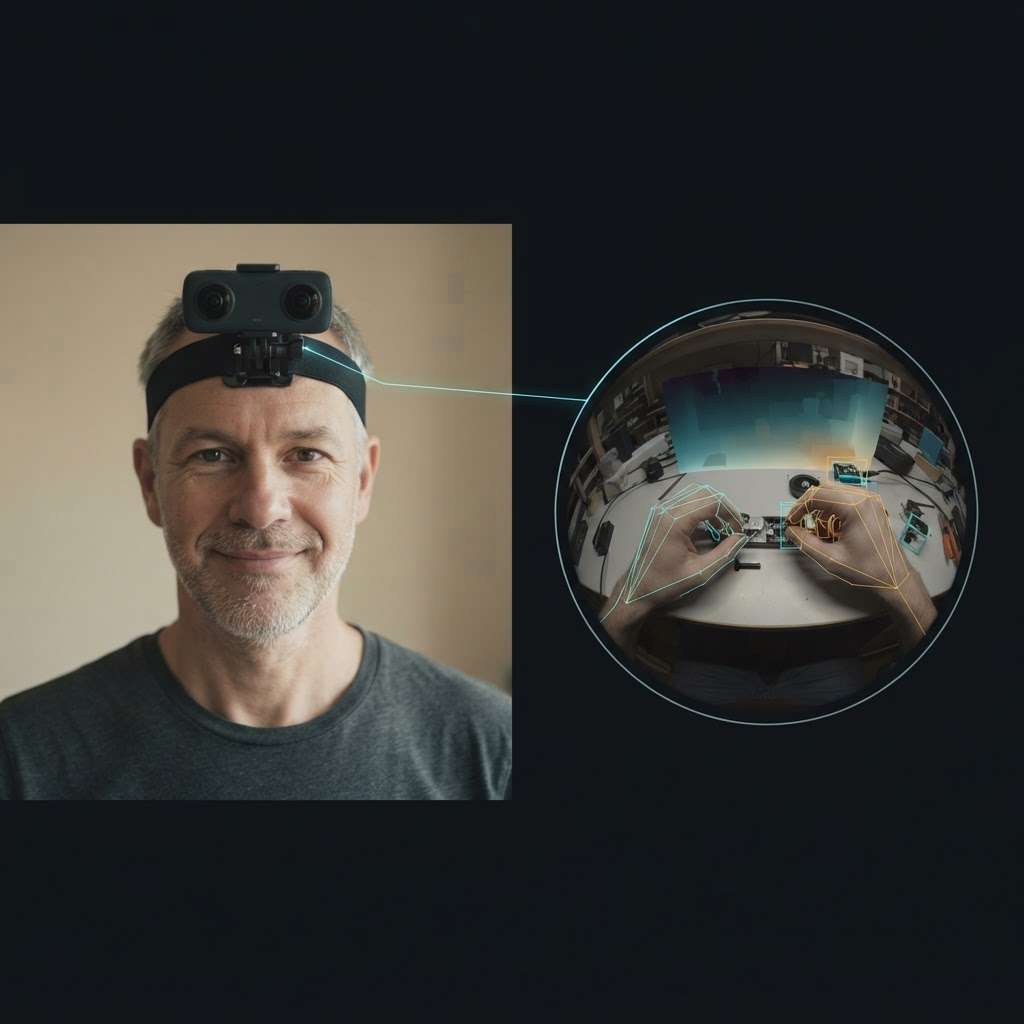
What a lab gets
The lab writes the tasks, environments, label depth and accept criteria. A public release was scoped for someone else’s question before yours existed.
Ten streams are hardware-aligned under 2 ms, and every session is calibrated twice and gated at 0.28 px, so multi-stream analysis starts from one clock.
Each episode links to a signed contributor release and an anonymization record, and a reject log ships with every batch.
RLDS, LeRobot and HDF5 are among the stated delivery formats, with converter source readable so the schema can be retargeted to your own loader.
Definition
A research lab usually needs first-person human video that matches one specific question: a family of tasks, a type of environment, a label set a method depends on. That means the dataset has to be scoped by the lab, with documented capture, labels, consent and licensing, not assembled from whatever a public release happens to contain.
This site names AI research labs among the teams it serves, and its Insta360 program page describes a workplace-routine collection for an embodied AI research lab. It names no universities or academic labs as buyers, no lab or researcher as a client, and no academic pricing or grants, so this page makes none of those claims.
The data is human capture. A contributor wears the rig and performs tasks from the spec, so the output is first-person human video with synchronized streams and labels, not robot trajectories or teleoperation logs.
Custom vs. public
Use a public dataset when it already matches your tasks and you are exploring. Commission custom data when the gap is specific: a task, an environment or a label the public releases do not cover, or terms that do not fit how you intend to use the data.
The EgoVerse authors state the problem directly: existing human datasets are “often limited in scope, difficult to extend, and fragmented across institutions.” Their answer is a shared platform that takes contributions from individual researchers, academic labs and industry partners. A custom collection is the other route: you write the scope and we capture to it.
Terms matter as much as content. Many public egocentric datasets are released for academic benchmarking under terms that do not grant commercial training rights, which this site covers in its guide to research-only versus commercial dataset licenses. The first table compares EgoVerse and Egocentric-10K, using their official sources, with a custom collection. Where those sources do not state something, the table says so.
Skill spec
The skill spec is a written document that fixes what will be captured and how it will be judged before any footage is recorded. We draft the first version with you on a call. The second table lists what it sets and where the site states each item.
Many research programs start with a Spec Pilot, a small first batch that proves the spec and accept criteria on real footage before volume scales. The pilot is quoted for reach, timeline and price like any other order.
Anything the spec leaves open stays open in writing. Contributor counts, scene counts, hours and regions are set per program in the skill spec; this page states none of them.
Capture and labels
The instrumented tier is a head-mounted stereo rig. It records first-person RGB, with metric depth recovered from the calibrated stereo rig rather than a standalone depth sensor, and 6-DoF IMU data at 200 Hz from head- and wrist-mounted sensors. The wider stack is ten streams: a 4K head camera, two wrist cameras, depth, IMU, 3D hand and body pose, instance segmentation and action labels.
Labels follow the delivered episode schema: hand_joints with hand_visible flags, body_joints, contact_events, instance_masks, objects, action_segments and gaze_target. Which of them a program attaches is set in the skill spec. The third table maps each part of the setup to where it is recorded in the episode.
Calibration is part of the data. Each session is solved twice, before and after capture, with the drift between the two written into the episode metadata, so a lab can filter on it rather than trust a summary.
Validation
Validation runs against signed accept criteria written into the spec. A reject log ships with every batch. An episode is accepted only if RMS reprojection stays under 0.28 px and calibration drift is within tolerance; otherwise it goes to the reject log, which you can see.
At ingest, episodes are machine-checked against the criteria in the fourth table, and a human reviewer then checks each episode against the task spec. Rejected items are recaptured at our cost rather than shipped with a caveat, and billing is per validated hour.
This describes our acceptance process. It is not a claim about how a delivered dataset performs in any particular model or experiment.
License and formats
The license is perpetual, irrevocable and worldwide, with the data buyer-owned and non-exclusive by default. Training, evaluating, fine-tuning and deploying models, including commercial ones, is permitted. Exclusivity is available per skill line or per environment as a separate term. The executed agreement controls.
The site states no terms for publication or redistribution of results or derived data. If your lab needs them, raise it before the spec is signed so it is settled in the agreement rather than assumed.
Delivery is in the format your stack reads: RLDS, LeRobot and WebDataset, plus HDF5, zarr and Rerun .rrd. The HDF5 layout, including stream names such as streams/depth_mm and streams/imu_head, is on the custom HDF5 page and the episode schema page.
Consent and privacy
Every contributor signs a written release before capture, and each delivered episode links to that record through consent artefact IDs in the batch data card. The consent chain has six checkpoints, from before capture to after delivery, and a break at any one discards the footage rather than shipping it at a lower grade.
At ingest, automated detection finds faces, plates and screens and blurs them. A human reviewer confirms that no un-consented person is identifiable in any frame, and footage that cannot be de-identified is discarded.
The provenance page publishes the release and the anonymization page describes the full pass. We make no claim about institutional review board approval or any regulation; if your institution needs its own review, set the requirement per program in the skill spec. None of this is legal advice, and the executed agreement controls.
Getting started
Describe the question: the tasks, environments and labels your experiment needs. That becomes a written spec, quoted for reach, timeline and price before any capture begins, and many labs start with a Spec Pilot.
Where coverage for your tasks and regions is deep, the median time from signed spec to first validated batch is a median of 48 hours; where it is thin, three to four weeks while recruiting expands. Anything this page does not state is set per program in the skill spec.
At a glance
Every collection runs through the same seven-stage end-to-end custom collection pipeline. End-to-end custom data collection is a managed service that takes an AI data need from problem to owned dataset in a single accountable pipeline.
Comparison
| Attribute | EgoVerse (paper) | Egocentric-10K (card) | Custom lab dataset (this site) |
|---|---|---|---|
| Who sets the scope | A collaborative platform with contributions from individual researchers, academic labs and industry partners | Its authors; assess from the card | The lab, in the skill spec |
| Setting | Everyday environments | Collected exclusively in real factories | Set in the skill spec |
| Capture hardware | Project Aria glasses for academic partners; custom rigs for industry partners | Not covered here; see the card | Head-mounted stereo rig, depth from the calibrated rig |
| Labels | 3D hand and head poses, subtask-level descriptions | Not covered here; see the card | Episode-schema fields chosen per spec |
| Consent record per episode | Not stated in the abstract | Not stated here | Consent artefact IDs per episode in the batch data card |
| License | Not stated in the abstract | Apache 2.0 | Perpetual, irrevocable, buyer-owned, non-exclusive by default |
Skill spec
| Spec item | What it fixes | How the site states it |
|---|---|---|
| Tasks and skills | The behaviors the experiment needs, with task boundaries | Named in the skill spec |
| Environments | Where capture happens and which settings must be covered | Named in the skill spec; counts set per program |
| Contributors | Who captures, and the mix across contributors | Set per program in the skill spec |
| Capture tier | Which rig and streams | Instrumented head-mounted stereo rig, or a mix of tiers |
| Label depth | Which episode-schema fields are attached | Set in the skill spec |
| Accept criteria | What a batch must clear before delivery | Signed into the spec; reject log ships with each batch |
| Exclusivity | Whether a collection is exclusive to the buyer | Separate term, per skill line or per environment |
Capture setup
| Part | As stated on this site | Where it is recorded |
|---|---|---|
| Head-mounted stereo rig | First-person RGB from a head-mounted stereo rig | Camera streams in the episode |
| Depth | Metric depth recovered from the calibrated stereo rig, not a standalone sensor | streams/depth_mm and streams/depth_conf |
| IMU | 6-DoF at 200 Hz from head- and wrist-mounted sensors | streams/imu_head, imu_wrist_l, imu_wrist_r |
| Hand and body pose | 3D hand and body pose with visibility flags | annotations: hand_joints, hand_visible, body_joints |
| Task structure | Action segments with labelled boundaries; contact events | annotations: action_segments, contact_events |
| Objects | Per-frame instance masks and object labels | annotations: instance_masks, objects |
| Sync | Hardware-triggered off one clock; 2.0 ms ceiling | Reject flags in the episode metadata |
| Calibration | Twice per session; reprojection under 0.28 px | calibration/rms_reproj_px and calib_drift_mm |
Acceptance
| Reject criterion | What it protects | Outcome |
|---|---|---|
| Sync breach beyond the ceiling for more than three consecutive frames | Alignment of video, depth, IMU and pose | Reject log; recaptured at our cost |
| Calibration drift beyond tolerance between opening and closing solves | Geometry between head, wrist and depth | Reject log; recaptured at our cost |
| Manipulated object out of frame for more than 15 percent of the episode | Task visibility | Reject log; recaptured at our cost |
| More than 35 percent invalid depth pixels in the manipulation region | Depth usability | Reject log; recaptured at our cost |
| An undocumented bystander | Consent and privacy | Footage discarded or held |
| A mismatch against the named skill spec | The task you ordered | Reject log; recaptured at our cost |
FAQ
Sources
Tell us the tasks, environments and labels your experiment needs. We write them into a spec, quote reach, timeline and price, and a first validated batch arrives in a median of 48 hours where coverage is deep.