Frontier AI labs

Custom Data Capture for Frontier AI Labs

Frontier AI training data scoped to your own spec: custom egocentric capture on demand, aligned across ten synchronized streams, validated before delivery, and licensed to your lab.
Streams
Ten, synced under 2 ms
First batch
Median 48 h
Billing
Per validated hour
License
Buyer-owned
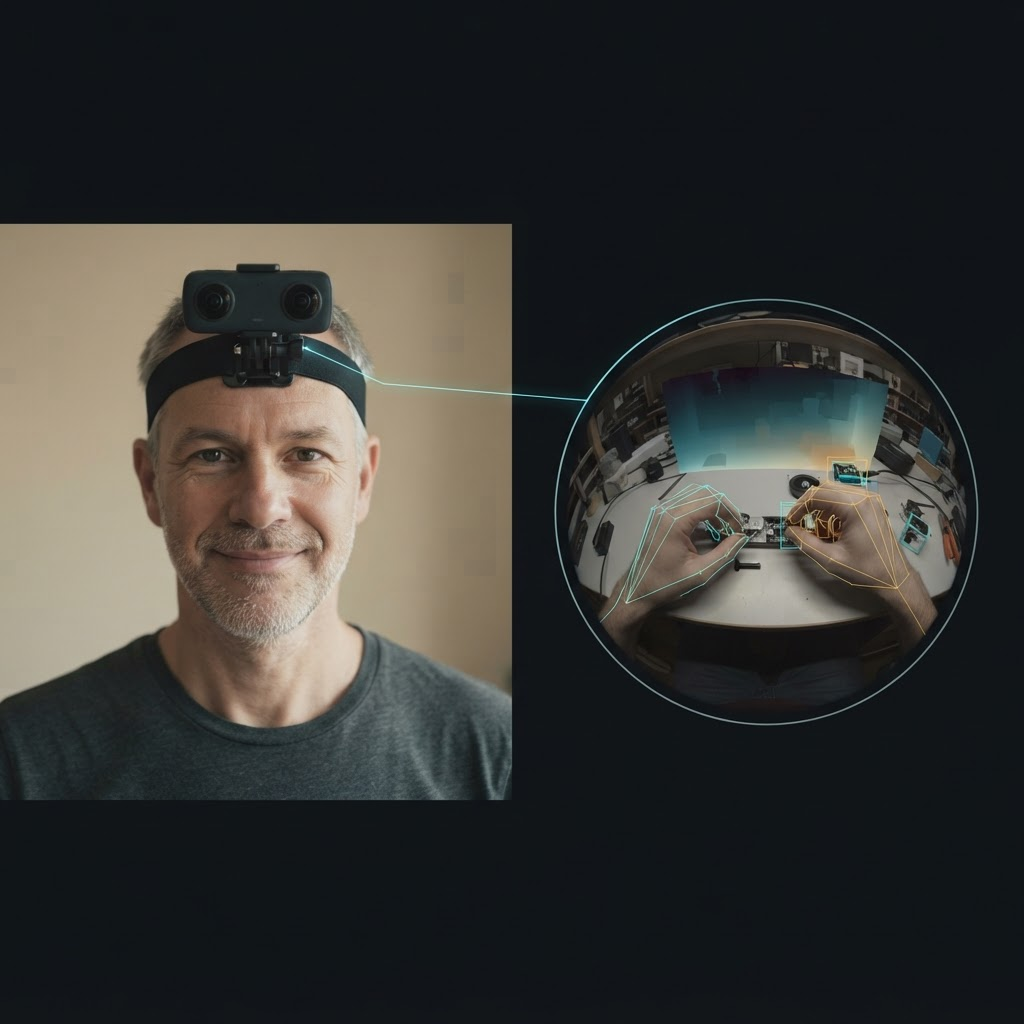
A contributor wearing a head-mounted camera beside a graphic of the first-person feed and annotation layers it produces.
Custom capture starts from the behavior your model is missing, recorded from the viewpoint it will act from.

Requirements

What do frontier labs need from real-world data?

01

Data scoped to the failure, not the catalog

Frontier AI training data has to target the behaviors a model is actually missing. A custom spec fixes tasks, environments, and regions to your eval, so custom egocentric data for frontier labs lands where the loss is.

02

Every stream on one clock

Ten synchronized streams per episode (4K head camera, two wrist cameras, depth, IMU, 3D hand and body pose, segmentation, and action labels), hardware-aligned under 2 ms.

03

Validated hours, not raw footage

Every item is measured against signed accept criteria and reviewed before delivery. You are billed per validated hour, and each batch ships with its reject log.

04

Rights you can ship on

A perpetual, buyer-owned commercial license backed by a documented consent chain, so a model trained on the data can go into a product.

Off the shelf

Why do off-the-shelf datasets fall short for frontier labs?

An off-the-shelf dataset was scoped for someone else's model. Its tasks, environments, and regions were fixed before your failure modes were known, and every buyer trains on the same hours, so it rarely closes the specific gap a frontier model is failing on.

Rights are the second gap. Before a commercial training run you have to confirm that each dataset permits commercial use and that its consent covers it. A custom collection is licensed to you and backed by a documented consent chain from day one.

The spec

How does a custom data capture spec work?

You describe the behavior your model is missing. We turn it into a written spec covering tasks, environments, regions, capture tier, annotation depth, and accept criteria, then quote reach, timeline, and price against that document before any capture begins.

The collection runs through the same seven-stage end-to-end custom collection pipeline as every Firsthand program: contributor recruiting, capture, per-batch QA, anonymization, and licensed delivery. Rejected items are recaptured at our cost.

Fast · on demand

How fast does a first batch ship?

Where coverage is already deep, the first validated batch lands in a median of 48 hours from signed spec. Thin environments such as construction, clinical, agriculture, and hospitality typically take three to four weeks, because vetting operators there is the bottleneck, and we quote that timeline up front.

After the first batch, delivery is rolling. On-demand top-ups run against the same spec and accept criteria after each training run, so new data stays consistent with what you already hold.

Rights

What do licensing and consent look like?

Every custom collection ships under a perpetual, buyer-owned commercial license, and exclusivity is available so the data is never resold. Each episode links to a signed contributor release through a documented consent chain.

Faces, plates, and screens are detected and irreversibly blurred at ingest, and a reviewer confirms the result before anything ships. The anonymization record is delivered with the data.

Requirement vs delivery

What does a frontier lab get, requirement by requirement?

Frontier lab data requirements and what a Firsthand custom collection delivers for each.
RequirementWhat Firsthand delivers
StreamsTen synchronized streams: 4K head camera, two wrist cameras, depth, IMU, 3D hand and body pose, segmentation, action labels
SyncHardware-synchronized on one clock, under 2 ms across streams
Annotations3D hand and body pose, instance segmentation, action segments, grasp and contact events
QualityMeasured against signed accept criteria; billed per validated hour; reject log with every batch
TimelineFirst validated batch in a median of 48 hours (deep coverage); three to four weeks in thin environments
ConsentSigned contributor release per episode; documented consent chain; faces, plates, and screens blurred and human-reviewed
LicensingPerpetual, buyer-owned commercial license; exclusivity available
FormatsRLDS, LeRobot, WebDataset, plus HDF5, zarr, and Rerun .rrd

Every collection runs through the same seven-stage end-to-end custom collection pipeline.

FAQ

Custom data capture for frontier AI labs, answered.

What is custom data capture for frontier AI labs?
It is real-world, first-person training data collected against a lab's own written spec instead of licensed off the shelf. The lab sets tasks, environments, and accept criteria; Firsthand handles contributors, capture, QA, consent, and delivery.
How is custom data capture billed?
Per validated hour, quoted against the written spec before any capture. You pay only for data that clears the accept criteria, and rejected items are recaptured at our cost.
Can a frontier lab keep the data exclusive?
Yes. Custom collections ship under a perpetual, buyer-owned license, and exclusivity is available so the data is never resold to another buyer.
Which delivery formats are supported?
RLDS, LeRobot, and WebDataset, plus HDF5, zarr, and Rerun .rrd. Converter source is readable, so you can retarget the schema to your own loader.
How precise is the cross-stream sync?
All streams are hardware-synchronized on a single clock, with alignment under 2 ms, so actions line up with what each camera saw.
Can we start with a small pilot?
Yes. A Spec Pilot is a small, fast first batch that proves the spec and accept criteria before you scale volume on demand.
Sources

Where are the delivery formats documented?

Request a custom dataset.

Tell us what your model is missing. We will quote reach, timeline, and price against a written spec, with a first validated batch in a median of 48 hours where coverage is deep.