Countries named, not implied
The country hub lists every country in the commercial program by region, and each links to its own page with settings, consent handling, delivery and FAQ.
Multi-country
What is included
The country hub lists every country in the commercial program by region, and each links to its own page with settings, consent handling, delivery and FAQ.
Every contributor works to the same written skill spec, and every episode is checked against the same accept criteria, whichever country it was recorded in.
Where a legal basis is on file it is named. Where it is not, the site prints no statute and the basis is confirmed per engagement before capture.
Each batch arrives with its data card, so the countries of capture and the consent basis are recorded next to the footage.
Definition
Egocentric data is video recorded from the point of view of the person doing the work, with their hands, tools and the objects they handle in frame. Multi-country collection runs that same capture in more than one country inside a single program, so one dataset spans several markets instead of one.
This page is about the custom-collection service, where you write down what the model is missing and contributors are recruited to capture exactly that. It is not a catalogue of footage we already hold, and it states no hour count for any country.
The scope is commercial settings only: retail floors, warehouses, commercial kitchens, automotive service bays, and tool-use and assembly work. Household footage is outside this program.
Why geography
The site’s country pages put it plainly: geography is a diversity axis in its own right. Packaging, tools, store layouts and work habits differ from market to market, and a model trained on one country’s footage quietly overfits to it. Adding a country to a spec is how a program widens that spread on purpose instead of collapsing onto whoever was easiest to recruit.
The global robotics data guide gives the same reasoning: a model trained only on one region can stumble when it meets another. It lists what varies across a global collection as environments, objects, people, routines, and languages and locales.
Countries and regions
The commercial program is organised into seven regions: North America, Central America and the Caribbean, South America, Asia-Pacific, the Middle East, Africa and Europe. The first table below lists every country in each region exactly as the country hub does, and links to the region pages are in the related links further down.
A country’s status says how much the site has on file for it. For some countries the consent framework is already documented, so a named legal basis is printed. For others the legal basis and environment clearance are confirmed per engagement, before capture starts, and written into the spec you approve. The second table sets out the three statuses.
One spec
The global robotics data guide states the rule: diversity is only useful if it comes from the world, not from the capture. If each location used a different camera, different sync or a different idea of a valid episode, the model would learn capture artifacts instead of task variation. The fix it describes is to hold everything except the environment fixed.
In practice the skill spec is the fixed point. It states the tasks, environments, objects and streams, how many attempts, what counts as a completed attempt, and the accept criteria signed before capture begins. The same spec goes to every contributor in every country, and the project sets the minimum device spec, so contributors whose device does not meet it are not admitted to that project.
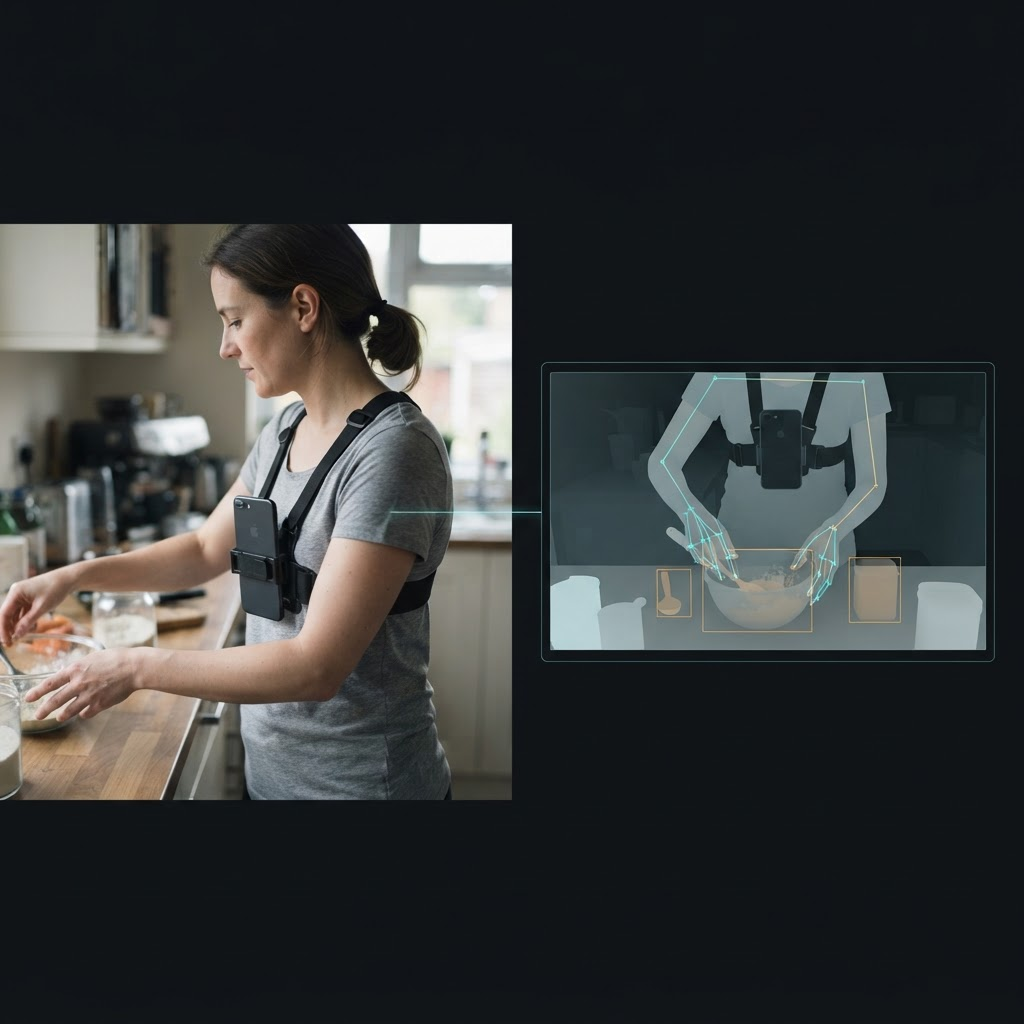
The capture tier can be a recent-generation smartphone in a chest mount, a 360 head mount for wider context, or the full instrumented rig with a head-mounted camera, dual wrist cameras, depth and IMU on a shared clock. The tier can step up under the same spec and the same QA bar.
Consent and jurisdiction
The consent chain does not change by country: releases are collected before capture, and contributors stop recording when an un-consented person enters the manipulation region. Every hour ships with its consent record, so the provenance of a clip can be traced back to a signed release.
What changes is the legal basis the site can print. For the countries in the legal-basis-on-file status, the country pages name the basis, such as CCPA / CPRA for the United States, PIPEDA for Canada, UK GDPR for the United Kingdom and GDPR Art. 6(1)(a) for Germany, the Netherlands, Poland and Portugal, and link the official regulator or statute page. For every other country the site prints no statute, which it describes as deliberate: it does not name a legal basis for a country it has not papered.
A documented basis is a starting point, not a substitute for the engagement paperwork. Environment access and site permission are still confirmed for every location a contributor proposes. De-identification is the same everywhere: faces, licence plates and screens are detected, tracked across frames, redacted and then checked in a human review step. This page makes no compliance claim and nothing here is legal advice, so what applies to your use in each country is a question for your counsel.
Coverage and validation
Each batch arrives with its data card, the consent artefact IDs listed per episode, the signed accept criteria it was measured against, and the reject log. The data card records the jurisdictions of capture and the consent basis, the de-identification pass, and which cells of the spec’s condition matrix were captured and what was rejected.
That makes the countries of capture a recorded property of the batch rather than a sales claim. The site does not state a per-country breakdown field on the card, so this page does not invent one. If you want coverage reported per country, write it into the spec before capture.
Validation is the same in every country. Episodes are machine-checked against the reject criteria, then a human reviewer checks each one against the task spec. Rejected episodes go to the reject log and are recaptured at our cost, and only footage that clears the criteria is billed as a validated hour. The egocentric dataset with a data card page covers the card in full.
Formats and licensing
Footage from every country is delivered in the same formats as any other program: RLDS, LeRobot, WebDataset, HDF5, zarr and Rerun .rrd, each mapped to the canonical episode schema, with readable converter source alongside so the schema can be retargeted to your loader. Annotation depth, from action segments to hand pose, is whatever the spec asked for.
The data ships under a perpetual, irrevocable, worldwide, buyer-owned license that is non-exclusive by default. Terms such as exclusivity are the ones written into the order form, which governs. The data card holds the provenance, including the jurisdictions of capture, and the order form holds the license terms.
The site states no separate format, schema or license for any one country: a multi-country delivery is one dataset in one schema.
Speed
From signed spec to first validated batch, the timeline is a median of 48 hours where coverage is deep and three to four weeks where it is thin and contributors need to be recruited first. The country pages add that listed environments are where a spec can usually start fastest, and that other commercial environments are still recruited to spec when a program asks for them.
Most programs begin with a Spec Pilot, a small first batch that proves the spec and accept criteria on real footage before you scale. Pricing is quoted per engagement, not from a rate card, and billed per validated hour. The spec is quoted for reach, timeline and price before any capture begins.
Limits
It does not state a headcount, an hour count or a sample size for any country, because the site does not. It does not guarantee that a country not in the hub table can be added on a given timeline, because that is quoted against the spec. And it does not make a dataset compliant in any jurisdiction.
Firsthand captures first-person human video, not robot or teleoperation data. The site states no measured effect of adding countries on any model, and this page claims no customer outcome.
At a glance
Every collection runs through the same seven-stage end-to-end custom collection pipeline. End-to-end custom data collection is a managed service that takes an AI data need from problem to owned dataset in a single accountable pipeline.
Countries
| Region | Countries in the hub table | Legal basis on file |
|---|---|---|
| North America | United States, Canada and Mexico | United States (CCPA / CPRA), Canada (PIPEDA) and Mexico (LFPDPPP) |
| Central America & Caribbean | Belize, Costa Rica, El Salvador, Guatemala, Honduras, Nicaragua, Panama and Puerto Rico | None on file; confirmed per engagement |
| South America | Argentina, Bolivia, Brazil, Chile, Colombia, Ecuador, Paraguay, Peru, Uruguay and Venezuela | Brazil (LGPD) |
| Asia-Pacific | Australia, Japan, New Zealand, Singapore, South Korea, Taiwan, India, Philippines and Vietnam | Japan (APPI), Singapore (PDPA) and South Korea (PIPA) |
| Middle East | Qatar, Saudi Arabia and United Arab Emirates | None on file; confirmed per engagement |
| Africa | South Africa, Nigeria and Kenya | None on file; confirmed per engagement |
| Europe | United Kingdom, Germany, Netherlands, Poland, Portugal, Spain and Ukraine | United Kingdom (UK GDPR), Germany (GDPR Art. 6(1)(a)), Netherlands (GDPR Art. 6(1)(a)), Poland (GDPR Art. 6(1)(a)) and Portugal (GDPR Art. 6(1)(a)) |
Status
| Status | What the site prints | Countries |
|---|---|---|
| Legal basis on file | A named legal basis is printed, and the commercial environments the coverage data lists for that country | United States, Canada, Mexico, Brazil, Japan, Singapore, South Korea, United Kingdom, Germany, Netherlands, Poland and Portugal |
| Listed capture country | The country is a listed capture country; no statute is printed and the legal basis is confirmed per engagement | Australia, India, Philippines, Vietnam, Nigeria, Kenya and Spain |
| Recruited to spec | Contributors are recruited to your spec; no statute is printed and the legal basis and site clearance are confirmed per engagement | Every other country in the hub table |
Consistency
| Item | Held constant across countries | Set per country |
|---|---|---|
| Skill spec | One written spec per task, used by every contributor | Which countries the spec names |
| Capture rig | Same head-mounted, wrist, stereo, depth and IMU setup on the rig tier | Capture tier chosen in the spec; minimum device spec set by the project |
| Sync tolerance | 1.12 ms median, 1.94 ms p99, 2.0 ms reject ceiling | Nothing |
| QA rule | The same written accept and reject rule; hours counted only once validated | Nothing |
| Consent flow | A consent chain for every contributor, in every country | The legal basis printed, where one is on file |
| Anonymization | Faces, licence plates and screens redacted, then human-reviewed | Nothing |
| Delivery | RLDS, LeRobot, WebDataset, HDF5, zarr or Rerun .rrd with a data card | Nothing |
| Environments | Commercial settings only | Which environments are listed for the country in the coverage data |
The data card
| Item | What the data card records | Level |
|---|---|---|
| Jurisdictions of capture | Where the footage was captured | Batch |
| Consent basis | The basis on which contributors consented | Batch |
| Consent artefact IDs | The release behind each episode | Episode |
| De-identification pass | Detector version, pass timestamp and reviewer confirmation | Episode |
| Coverage | Spec condition-matrix cells captured and what was rejected | Batch |
| Reject log | Episodes screened out, with reasons; ships with every batch | Batch |
| Per-country breakdown field | Not stated; agree it in the spec if you need it | Not stated |
FAQ
Sources
Name the countries, settings and tasks. We write them into a spec, quote reach, timeline and price before capture begins, and ship every batch with its data card.