Capture setting

Egocentric Tabletop Manipulation Data

A tabletop is a capture setting, not a skill: one work surface, a bounded workspace, a set of objects and hands reaching across it. We capture it egocentrically, from the viewpoint a tabletop policy will act from, against a written spec that names the tasks, the object set and the accept criteria.
Streams
Ten, synced under 2 ms
First batch
Median 48 h
Billing
Per validated hour
License
Buyer-owned
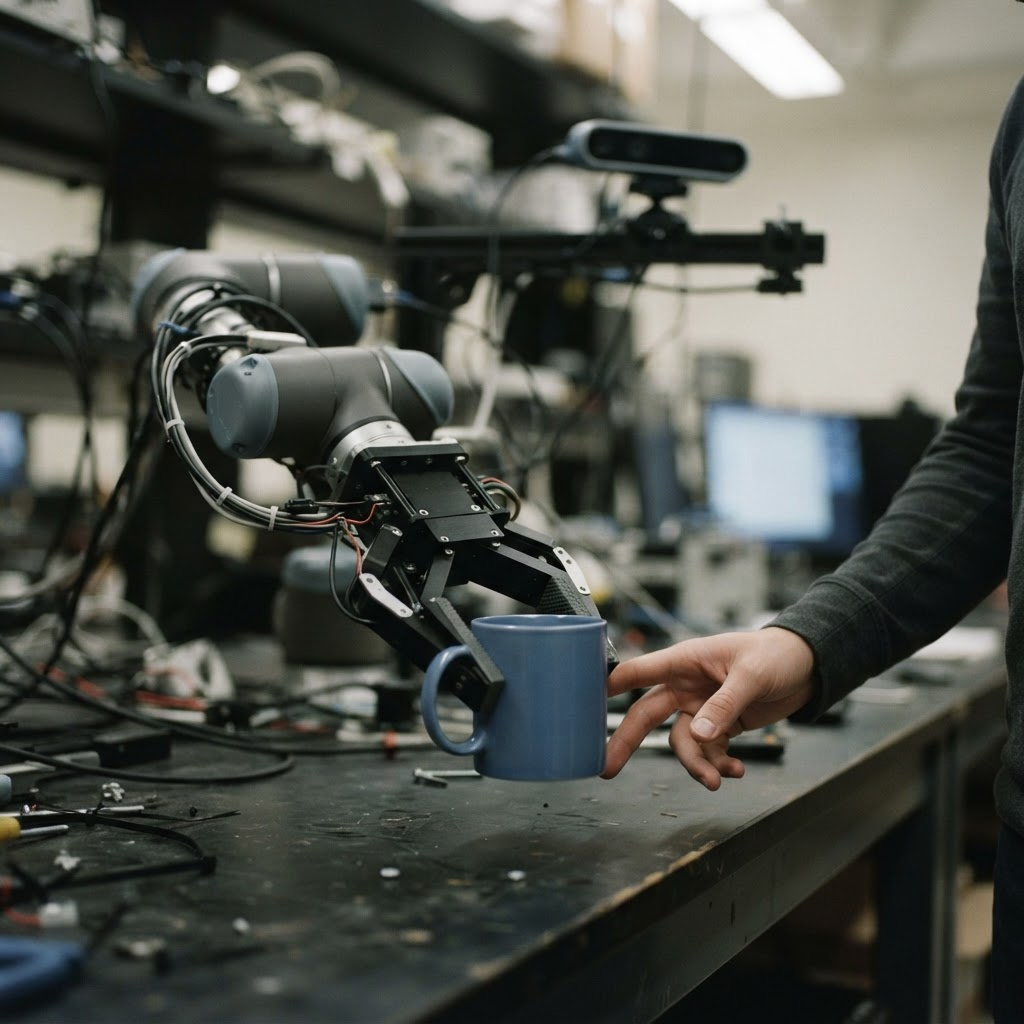
A human hand grasps an object mid-demonstration, with a depth sensor and annotated contact point visible.
A tabletop task is reaching, grasping and placing inside one bounded workspace, captured from the actor’s own viewpoint.

Requirements

What does tabletop manipulation data need?

01

The work surface in frame, from the actor’s viewpoint

A head-mounted camera keeps the work surface and the hands reaching across it in view from the viewpoint a tabletop policy will act from, with wrist-mounted cameras adding close-range detail where the hand meets the object.

02

Hand pose and contact, not just video

Per-frame 3D hand pose, 21 keypoints per hand with a visibility flag per joint, and contact events on grasp and release carry the detail that RGB video alone cannot resolve across a work surface.

03

Objects and target surfaces segmented

Instance masks on manipulated objects and target surfaces, with tracked IDs across the episode, keep each object and the surface it lands on identifiable through the whole task.

04

An object set written into the spec

The object set is a field of every skill spec. The site publishes no standing tabletop object list, so the set is named per program, along with start and goal locations.

05

Rights you can ship on

A perpetual, buyer-owned commercial license backed by a documented consent chain, so a policy trained on the data can go into a product.

Definition

What is tabletop manipulation data?

Tabletop manipulation is manipulation performed on a single, bounded work surface: the actor stays roughly in one place, the objects sit within arm’s reach, and the task is carried out by reaching, grasping, moving and placing things across that surface. Tabletop manipulation data is a recording of those tasks, together with the signals a policy learns from.

It describes a capture setting, not a skill. Pick and place, sorting, tool hand-off and two-handed assembly can all happen on a tabletop, and the same skills can also happen on a shelf, in a cart or across a room. This page covers the setting: what is in frame, what has to be written into the spec, and what the Firsthand site does and does not state about it.

Why a separate page

How is tabletop data different from pick-and-place, grasping or dexterous data?

Those pages are organized by manipulation primitive or by hand articulation. Egocentric pick and place data is the reach, grasp, transport and place motion. Egocentric grasping data is the grasp itself. Dexterous manipulation data is finger-level work, and bimanual manipulation data is two hands acting together. Each names something the hands do.

Tabletop is the other axis: where the work happens. A buyer training a tabletop policy usually needs several of those primitives at once, inside one bounded workspace, with the objects, the start and goal positions and the surface itself under control. The questions that matter are different: how the work surface is framed, how the object set is chosen, how each take starts, and how the setup lines up with the robot’s own workspace.

Task families

Which task families happen on a tabletop?

The Firsthand site does not publish a tabletop-specific task list, so this page names families by the existing pages they map to rather than inventing a catalog. Pick and place, grasping, tool use and assembly, two-handed work, fine finger manipulation and failure and recovery can all run on a work surface, and each already has its own page with the labels it carries.

Where the site describes a family in a bench or kitchen setting, such as tool hand-off at a bench or food prep handling in a kitchen, the table says so. Treat it as a scoping aid: the tasks you need are named in the written skill spec, and anything the site does not state is set per program.

Workspace framing

How is the work surface framed in first-person capture?

The rig is worn, so framing follows the contributor’s head. The site states a head-mounted global-shutter camera at 3840 × 2160 and 60 fps with a 120° horizontal field of view, which keeps the work surface and the reaching hands in view from the same viewpoint a tabletop policy would act from. Two wrist-mounted cameras at 1920 × 1080 and 60 fps, 100° horizontal field of view, add a close-range view of where the hand meets the object.

Depth comes from an active-stereo sensor at 848 × 480 and 30 fps with a stated range of 0.3 to 4 m. The site does not state a standard camera height, table size, working distance or framing protocol, so any of those that matter to your robot are written into the spec rather than assumed.

Matching the viewpoint to a robot is the reason framing matters. In the published EgoScale work, the aligned human demonstrations were collected with the same camera configuration as the robot, with matched viewpoints and calibrated intrinsics. The Firsthand site states that intrinsics and extrinsics are re-solved with a checkerboard target at the start and end of every session, so drift is detectable; whether a rig should match a particular robot is a spec conversation.

Object sets

How is the object set specified?

Every Firsthand custom collection starts with a written skill spec that names the tasks, the setting, the object set, the capture tier, the annotation depth and the accept criteria. For tabletop work the object set carries the most weight, because it decides what the policy sees across the surface.

The site publishes no standing tabletop object list, so the set is named per program, along with start and goal locations. On the labeling side, the site states instance masks on manipulated objects and target surfaces, with tracked IDs across the episode, so each object and the surface it lands on stay identifiable through the task. Who supplies the objects is not stated.

Scene resets

How are scene resets handled between takes?

The site states no scene-reset protocol, so this page does not describe one. One term needs care: the household page lists surface reset as a chore category, meaning tidying a surface as the task itself. It is not a between-take reset procedure.

What the site does state is how a take is bounded and checked. Action segments carry start and end to the frame, every batch is validated against the signed accept criteria with a reject log, and rejected items are recaptured at Firsthand’s cost. A start-state definition is a reasonable item to put in the spec. For context, EgoScale’s robot evaluations used an image overlay of the target initial scene configuration to reduce variability in initial conditions; that describes evaluation in that paper, not a Firsthand practice.

Streams and labels

Which streams and labels come with tabletop data?

The same streams and labels as every Firsthand custom collection: ten streams hardware-triggered onto one clock and aligned under 2 ms. Hand pose is 21 keypoints per hand in 3D with a per-joint visibility flag, and contact events mark grasp and release. Body pose is 24 joints. Action segments use a verb and noun taxonomy of 97 verbs and 512 nouns, start and end to the frame, human-reviewed.

The second table lists each stream with its stated spec and why it matters on a work surface. Depth carries a per-frame confidence map, and pixels beyond the depth sensor’s reliable range are flagged rather than interpolated, so a surface near the edge of the range is marked, not guessed.

Failure cases

Are failed grasps and dropped objects included?

Missed grasps, dropped items and mis-placed objects are captured and action-segmented alongside clean takes rather than discarded, and they count toward validated hours. On a work surface that matters because a policy trained only on clean takes has no model of recovery.

Failure and recovery episodes are labeled against the same accept criteria as clean takes. The site does not publish a tabletop-specific failure list; failure scenarios are named in the spec before capture starts, so each becomes a coverage cell that can be counted and checked.

The spec

How do you scope a custom tabletop collection?

You describe the tasks, the work surface and any workspace constraints, the objects, and the start and goal locations your policy needs. We turn that into a written spec covering tasks, environments, capture tier, annotation depth and accept criteria, then quote reach, timeline and price against that document before any capture begins.

The collection runs through the same seven-stage end-to-end pipeline as every Firsthand program: contributor recruiting, capture, per-batch QA, anonymization and licensed delivery. A Spec Pilot, a small, fast first batch, can prove the spec before you scale volume.

Published research

What does published research say about tabletop data?

The EgoScale paper is a useful reference because its aligned mid-training dataset is tabletop by design. It comprises 344 tabletop manipulation tasks, each captured in approximately 30 human trajectories and 5 robot trajectories, totaling about 50 hours of human data and 4 hours of robot data. The authors describe it as focusing on tabletop tasks that match the robot’s workspace and kinematics.

That paper collected its data with a different stack from the one described on this site: motion-capture trackers and gloves for human hand motion, and teleoperated robot data. The Firsthand site states no robot capture, no teleoperation and no motion-capture glove capture, and this page implies none. The third table sets the two side by side. The paper is cited as published research; no relationship with its authors is implied.

Fast · on demand

How fast does a first tabletop batch ship?

Where coverage is already deep, the first validated batch lands in a median of 48 hours from signed spec. Thin environments typically take three to four weeks, because vetting operators there is the bottleneck, and we quote that timeline up front.

On-demand top-ups run against the same spec and accept criteria after each training run, so new tabletop data stays consistent with what you already hold.

Rights

How is tabletop data licensed and delivered?

Every custom collection ships under a perpetual, buyer-owned commercial license, and exclusivity is available so the data is never resold. Each episode links to a signed contributor release through a documented consent chain.

Faces, plates and screens are detected and irreversibly blurred at ingest, and a reviewer confirms the result before anything ships. Delivery formats are RLDS, LeRobot and WebDataset, plus HDF5, zarr and Rerun .rrd, with the anonymization record included.

Setting vs the site

What does the site state about tabletop capture?

Each element of a tabletop capture setting and what the Firsthand site states about it, with "not stated" where it states nothing.
Tabletop elementWhat the Firsthand site states
Work surface in frameHead-mounted global-shutter camera, 3840 × 2160 at 60 fps, 120° horizontal field of view, worn by the contributor
Close-range viewTwo wrist-mounted cameras, 1920 × 1080 at 60 fps, 100° horizontal field of view
Depth to objects and surfaceActive stereo, 848 × 480 at 30 fps, 0.3 to 4 m range, per-frame confidence map
Object setA field of every skill spec, named per program; no standing list published
Scene-reset protocolNot stated
Fixed tabletop rigNot stated; the stated rig is worn by the contributor
Tabletop-specific task listNot stated; tasks are named in the spec
Robot or teleoperation captureNot stated

Every collection runs through the same seven-stage end-to-end custom collection pipeline.

Task families

Which task families map to a work surface, and what labels carry them?

Task families that can run on a tabletop, where the site describes each, and the labels Firsthand delivers for it.
Task familyWhere the site describes itLabels that carry it
Pick and placeWarehouse pick-to-tote, retail shelf facing, kitchen food prep, tool hand-off at a bench3D hand pose · contact events · action segments · depth
GraspingNamed grasping tasks and objects in the spec3D hand pose · contact events at grasp · depth
Tool use and assemblyDriver and bit selection, clamp-and-align, measuring, fastening, tool hand-off3D hand pose · contact events · action segments · depth
Two-handed tasksBoth hands in frame, per-hand pose and contactPer-hand 3D pose · contact · one clock
Fine finger workFinger-level manipulation, not just the wrist21-keypoint hand pose · visibility flags · fingertip contact events
Failure and recoveryMissed grasps, drops and mis-placed objectsAction-segmented failure cases

Streams and labels

Which streams matter on a work surface?

Each stream or label with its stated spec and why it matters for tabletop work.
Stream or labelStated specWhy it matters on a work surface
Head camera3840 × 2160 · 60 fps · 120° HFOV · global shutterKeeps the surface and the reaching hands in view from the actor’s viewpoint
Wrist cameras × 21920 × 1080 · 60 fps · 100° HFOVClose-range view of hand-object contact
DepthActive stereo · 848 × 480 · 30 fps · 0.3–4 mMetric distance to objects and the surface, with a confidence map
IMU200 Hz · 6-DoFHead motion on the same clock as every other stream
Hand pose21 keypoints × 2 hands · per-joint visibilityFinger detail through grasp and release
Body pose24 jointsPosture and arm chain while reaching across the surface
Instance masksManipulated objects and target surfaces · tracked IDsSeparates each object from the surface it lands on
Action segments97 verbs · 512 nouns · frame-accuratePhase boundaries inside each task
Contact eventsOn grasp and releaseWhen fingers make and break contact

Published research vs the site

How does a published tabletop dataset compare with what the site states?

EgoScale’s published tabletop mid-training dataset beside what the Firsthand site states for the same items.
ItemEgoScale (published research)Firsthand site
Tabletop tasks344 tabletop manipulation tasks in the mid-training datasetNot stated; tasks are named per spec
Trajectories per taskAbout 30 human and 5 robotNot stated
ScaleAbout 50 hours of human data and 4 hours of robot dataSized per program in the spec
ViewpointSame camera configuration as the robot, matched viewpoints, calibrated intrinsicsHead-mounted and wrist-mounted cameras; calibration re-solved at the start and end of every session; robot matching set in the spec
Human motion captureTrackers and glovesHand pose, 21 keypoints × 2 hands, per-joint visibility
Robot dataTeleoperated robot trajectoriesNot stated
Scene start stateImage overlay of the target initial scene, in robot evaluationScene-reset protocol not stated

FAQ

Tabletop manipulation dataset, answered.

What is egocentric tabletop manipulation data?
It is first-person video of a person performing manipulation tasks on a single work surface, captured against a written spec with 3D hand pose, contact events, depth and action segments. Firsthand handles contributors, capture, QA, consent and delivery.
How is it different from pick-and-place or grasping data?
Pick and place and grasping are manipulation primitives, defined by what the hands do. Tabletop is a capture setting, defined by where the work happens: a bounded work surface, an object set and start and goal locations. A tabletop spec usually draws on several primitives at once.
Does Firsthand capture on a fixed tabletop rig?
Not stated. The rig the site describes is worn by the contributor: a head-mounted camera, two wrist-mounted cameras, a depth sensor and IMUs. Any other camera arrangement would be set in the written spec.
Can we choose the objects and the scene layout?
The object set is a field of every skill spec, and start and goal locations are named in it. The site publishes no standing object list and states no scene-reset protocol, so both are confirmed per program.
Is robot or teleoperated data included?
Not stated. The site describes human egocentric capture and states no robot capture and no teleoperation. EgoScale’s mid-training data included teleoperated robot trajectories; that is a description of that paper, not of Firsthand.
How fast does a first batch ship, and how is it billed?
A first validated batch lands in a median of 48 hours from signed spec where coverage is deep, and three to four weeks where it is thin. Billing is per validated hour, quoted against the spec before capture, and rejected items are recaptured at our cost.
Sources

Where do the facts on this page come from?

Request a custom dataset.

Tell us the tasks, objects and workspace your tabletop policy needs. We will quote reach, timeline, and price against a written spec, with a first validated batch in a median of 48 hours where coverage is deep.