Same viewpoint, different search term
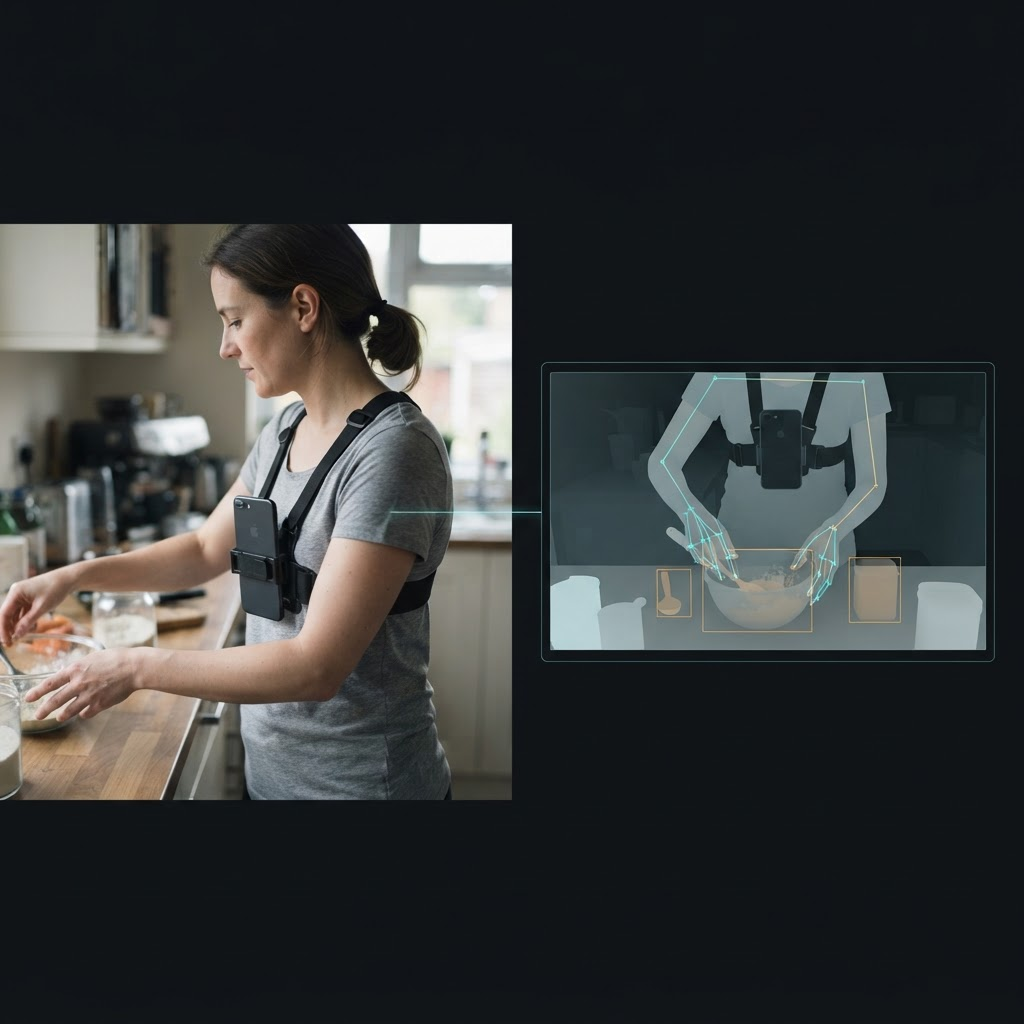
First-person, POV, and egocentric video all mean a camera worn or held at the actor’s own eye line, capturing what they see rather than how they look from outside.
First-person video
What is included
First-person, POV, and egocentric video all mean a camera worn or held at the actor’s own eye line, capturing what they see rather than how they look from outside.
Phone in a chest mount for breadth, a head-mounted rig when gaze and head motion matter, or a synchronized multi-camera rig when a model needs 3D hand pose and contacts.
Each batch is reviewed against written accept criteria, rejected items are recaptured at the provider’s cost, and faces, plates, and screens are blurred and reviewer-confirmed before delivery.
RLDS, LeRobot, WebDataset, HDF5, zarr, or Rerun .rrd, under a perpetual, buyer-owned commercial license.
Terminology
First-person video data is video recorded from the viewpoint of the person performing a task, captured with a camera mounted on the head, chest, or a pair of glasses rather than pointed at the actor from across the room. The frame shows hands, tools, and objects the way the actor themselves sees them during the task, instead of showing the actor’s body from an external angle.
That viewpoint matters for AI and robot training because a policy learning to manipulate objects needs to see the task the way a hand-eye system experiences it, not the way a bystander would film it. A third-person clip shows what a person looks like doing a task; a first-person clip shows what the task looks like from inside the doing of it.
Terminology
Yes. "First-person video," "POV video," and "egocentric video" describe the same capture viewpoint, a camera worn or held at the actor’s own eye line. The terms come from different communities: "egocentric" is the term used in the computer vision and robotics research literature, "POV" is common in consumer and creator contexts, and "first-person" is the plain-language version used by buyers describing what they need without the research jargon.
Because the underlying capture method, contributor recruiting, hardware tiers, annotation, and delivery are identical regardless of which term a buyer searches, a first-person video data collection engagement and an egocentric video data collection engagement are the same offer under different names.
Scope
A custom first-person video dataset starts with a written spec: which tasks, objects, and environments the footage needs to cover, which capture tier to use, how deep the annotation needs to go, and the accept criteria a batch has to clear before it ships. From there it covers contributor recruiting and briefing, capture against the spec, per-batch quality review, anonymization, documented consent, and delivery in a training-ready format under a commercial license.
Capture runs on one of three tiers. Phone tier uses a contributor filming hands-free with a phone in a chest mount, which is the fastest way to reach broad geographic and household diversity. Head-rig tier uses a head-mounted camera that matches the eye-line viewpoint and adds IMU data, for tasks where gaze and head motion are part of what the model needs to learn. Multi-camera tier synchronizes head, wrist, and depth streams on one hardware clock, for manipulation work that needs 3D hand pose and contact information.
Why first-person
Internet video and third-person footage show a task from outside: a camera across the room, or a creator’s edited clip shot for an audience rather than for a model. Neither shows the hand-object geometry, grasp points, or viewpoint changes a manipulation policy actually needs, because the camera was never placed where the actor’s eyes or hands were during the task.
First-person capture puts the camera at the actor’s own viewpoint on purpose, so the resulting frames show grasps, tool contact, and task-relevant motion the way an embodied system would encounter them. That is why egocentric or first-person data has become the standard capture viewpoint for pretraining and mid-training robot foundation models, ahead of internet-scraped or third-person footage.
Process
The engagement starts with a written spec: tasks, environments, regions, capture tier, annotation depth, and the accept criteria a batch has to clear, quoted for reach, timeline, and price before capture begins. Most programs start with a Spec Pilot, a small, fast first batch that proves the spec and QA bar hold on real footage before volume scales.
From there, capture runs through the same pipeline used across every program: contributor recruiting, capture against the spec, per-batch QA, anonymization, and licensed delivery, with rejected items recaptured at the provider’s cost. A median of 48 hours from signed spec to first validated batch applies where coverage is deep; where it is thin and contributors need to be recruited from scratch, a realistic timeline runs three to four weeks. On-demand top-ups run against the same accept criteria afterward, so new gaps that appear during training can be closed without renegotiating the spec from zero.
Quality & privacy
Every batch is reviewed against the accept criteria written into the spec before it ships, not sampled after delivery. Footage that does not clear the bar is rejected and recaptured at the provider’s cost rather than shipped with a caveat, so the bar set at the start of the engagement is the one every batch is actually held to at scale.
Because first-person footage is captured from the actor’s own viewpoint in real environments, it can pick up bystanders, license plates, or screens in frame. Those are detected and irreversibly blurred at ingest, and a human reviewer confirms the anonymization before anything ships, with the anonymization record delivered alongside the data.
Rights
Every contributor signs a documented release as part of the consent chain, and that record ships with the data rather than being kept as a one-time assurance behind the scenes. The finished dataset is delivered under a perpetual, buyer-owned commercial license, with exclusivity available so a given collection is never resold to another buyer.
That combination, a documented consent chain plus a license actually written for commercial training, is where several public first-person or egocentric corpora fall short, since many of them ship research-only terms or do not state a license at all.
Getting started
Start with the gap in your current data: which tasks, objects, or environments your model is weak on, not a target hour count. That becomes the written spec, tasks, environments, regions, capture tier, and annotation depth, quoted for reach, timeline, and price up front.
A Spec Pilot proves that spec on a small, fast first batch before any commitment to volume, so stream quality, annotation fidelity, and format compatibility can be checked before scale. From there the same pipeline scales the collection to the size the program needs, with on-demand top-ups available afterward.
At a glance
| Stream or label | What it is for |
|---|---|
| First-person RGB video | The core training signal: hands, tools, and objects from the actor’s own viewpoint |
| IMU (head-rig and multi-cam tiers) | Head motion and orientation, for tasks where gaze and head movement are part of the skill |
| Depth (multi-camera tier) | 3D hand pose and contact geometry for manipulation-focused models |
| Action segments and transcripts | Frame-accurate labels for what the actor is doing and narrating, for supervised training |
| Anonymization record | Documentation that faces, plates, and screens were detected, blurred, and reviewer-confirmed |
Every collection runs through the same seven-stage end-to-end custom collection pipeline.
Viewpoint comparison
| First-person video | Third-person video | Internet video | |
|---|---|---|---|
| Viewpoint | Actor’s own eye line; hands and tools as the actor sees them | External camera showing the actor’s body from outside | Whatever viewpoint the original creator filmed from |
| Hand-object geometry | Captured directly, matching how an embodied system encounters the task | Occluded or distant; not aligned to a model’s own viewpoint | Inconsistent; rarely aligned to any single viewpoint |
| Task coverage | Scoped to the written spec’s tasks and environments | Depends on what was filmed, not specified to a model’s gap | Whatever exists online; not controllable |
| Licensing | Perpetual, buyer-owned commercial license by default | Varies by source | Scraped video typically lacks commercial training rights |
| Consent documentation | Documented per-contributor consent chain delivered with the data | Varies | Usually absent |
FAQ
Sources
Tell us what your model is missing. We will quote reach, timeline, and price against a written spec, with a first validated batch in a median of 48 hours where coverage is deep.