Two capture tiers
An instrumented rig with wrist cameras, depth, and a hardware-triggered clock, or a lighter contributor-worn 360 camera on a head strap for broader reach where sub-millisecond sync and depth are not required.
Head-mounted capture
What is included
An instrumented rig with wrist cameras, depth, and a hardware-triggered clock, or a lighter contributor-worn 360 camera on a head strap for broader reach where sub-millisecond sync and depth are not required.
Intrinsics and head↔wrist↔depth extrinsics are solved before capture starts and solved again at the end, so drift across the session is a recorded number rather than an assumption.
Every episode is machine-checked for sync and calibration drift, then reviewed by a human against the task spec; rejected episodes are recaptured at the provider’s cost.
RLDS, LeRobot, WebDataset, HDF5, zarr, or Rerun .rrd, under a perpetual, buyer-owned commercial license.
Terminology
Head-mounted camera data collection means recording a task with a camera worn on the head, instead of a camera mounted on a tripod, held by a second person, or clipped to the wrist. The head position puts the camera close to the actor’s own eye line, so the resulting frame shows the environment, the target object, and the approach the way the actor themselves would see it while performing the task.
This is the hardware behind what the research and robotics literature calls egocentric or first-person video: the viewpoint is defined by where the camera sits on the body, and "head-mounted" describes the specific mounting point that produces it. A chest-mounted phone or glasses-mounted camera also produce an egocentric viewpoint, but "head-mounted" specifically refers to a camera fixed at head height, which is the mounting point used when gaze direction, head motion, and the widest stable environmental view matter most.
Hardware
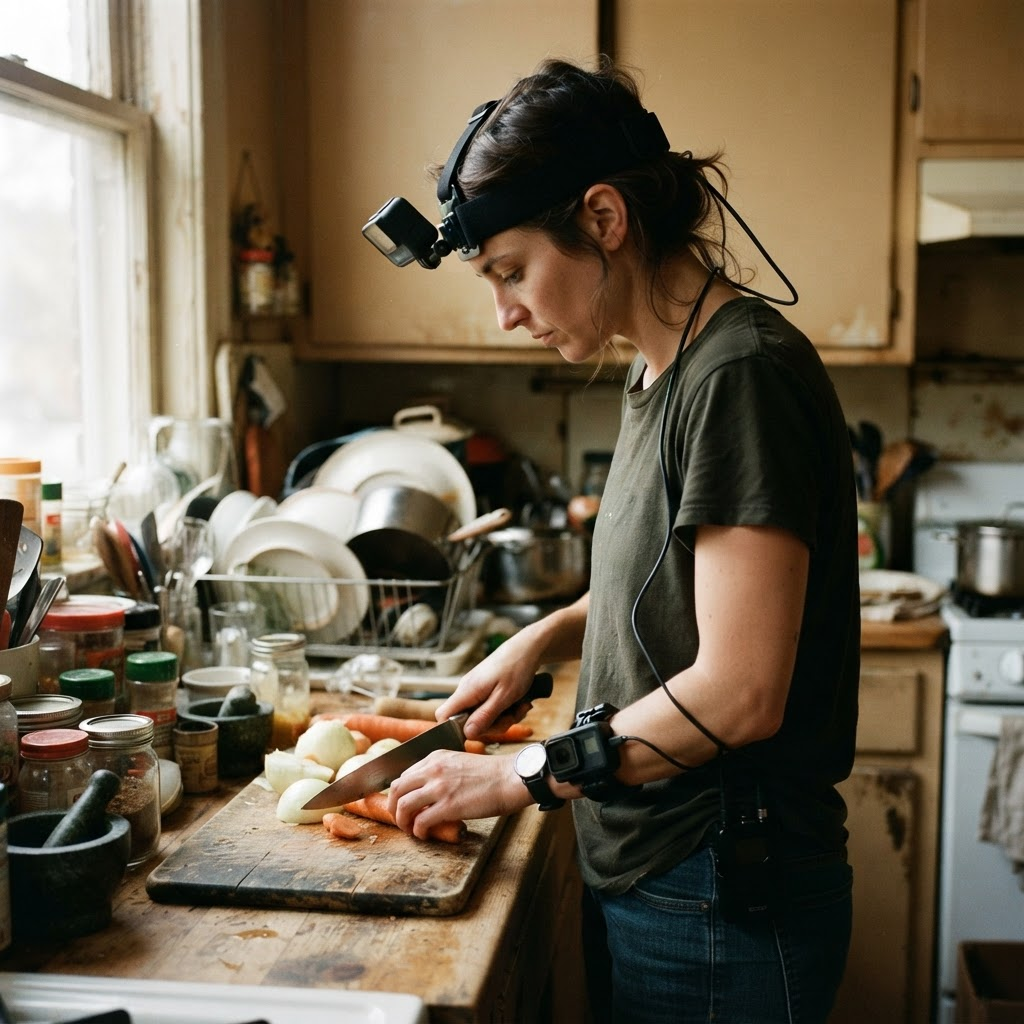
The instrumented head-mounted rig carries a global-shutter head camera, two wrist cameras, a depth sensor, and inertial measurement units, all triggered off a single hardware clock. The head camera is a Sony IMX585 global-shutter sensor with a 120° field-of-view M12 lens, mounted on a carbon headband that weighs 42 grams; the two wrist cameras are IMX290 sensors with a 100° lens each, worn on a velcro cuff with a rigid mounting plate.
Depth comes from an Intel RealSense D435if mounted on the forehead, 18 millimeters below the head camera. Three Bosch BMI088 inertial measurement units run at 200 Hz, one on the head and one on each wrist, so head motion and wrist motion are both recorded alongside the video. A PTP grandmaster clock and hardware trigger line in a 190-gram belt pack drive every sensor off the same timebase, and a 2-terabyte NVMe drive in the same belt pack stores up to six hours of continuous capture. The full instrumented rig weighs 640 grams worn.
Why head-mounted
A head-mounted camera gives a model the widest stable view of the environment and the task at once: the target object, the approach path, and the surrounding scene, the way an actor scans a room before reaching for something. That scene-level context is what a policy needs to localize objects and plan navigation between sub-tasks, and it is the view most robot pretraining and mid-training corpora are built on, because it is the viewpoint a robot’s own head or torso camera is designed to approximate.
A head-mounted view alone has a known weak point: once a hand closes in on an object, the hand and arm frequently occlude the head camera’s view of the exact contact point. That is the gap a wrist camera is built to cover, which is why most manipulation-grade collection pairs a head-mounted camera with wrist cameras rather than using the head view in isolation.
Head vs wrist
For most manipulation policies, yes. A head-mounted camera captures the actor’s wide egocentric view of the environment, the target object, and the approach; a wrist camera captures a close, occlusion-resistant view of the hand at the point of contact. The head view provides scene context and object localization; the wrist view provides grasp-level detail that survives the hand and arm blocking the head camera’s line of sight during contact.
Used together, head and wrist streams only produce a usable dataset if they share a clock and a known geometric relationship. Our rig hardware-triggers the head camera, both wrist cameras, depth, and IMU onto one clock, and solves head↔wrist↔depth extrinsics against a shared calibration target, expressed in the head-camera frame, so the two viewpoints are temporally and geometrically related rather than aligned after the fact. A full breakdown of when each viewpoint matters is in the head cameras vs wrist cameras comparison.
Capture tiers
The instrumented rig described above, with wrist cameras, depth, and a hardware-triggered clock, is the tier that every multi-stream claim on this site applies to: the sync ceiling, the calibration procedure, and 3D hand pose. It is the right tier when a policy needs depth, contact geometry, or sub-millisecond cross-stream sync.
The second tier is a contributor-worn dual-lens 360 camera clipped to a quick-release buckle on an elastic head strap, the setup behind the sample clips published on this site. It gives up depth, wrist views, and sub-millisecond sync, and in exchange it goes anywhere a person is willing to wear it, which is how coverage reaches a wide range of countries and households. Episode metadata labels which tier a given clip came from, so a buyer can filter on tier rather than infer it, and the two tiers can be mixed under a single spec when a program needs both broad reach and deep manipulation detail.
Calibration & sync
Every session on the instrumented rig is calibrated twice: once before capture starts, once after it ends. The opening solve covers a checkerboard target solve across 40 poses spanning every camera’s frustum, per-camera intrinsics solved independently to a reprojection error under 0.28 pixels, head↔wrist↔depth extrinsics solved against the shared target and expressed in the head-camera frame, and IMU bias and scale estimated from a static hold plus a figure-eight excitation. The closing solve repeats the whole procedure, and the drift between opening and closing is written into the episode metadata rather than assumed away.
All sensors on the instrumented rig are hardware-triggered off a single PTP grandmaster clock, with a 2.0 millisecond sync ceiling; measured cross-stream offset across sampled shipped episodes runs well under that ceiling. At ingest, episodes are machine-checked against reject criteria: a sync breach beyond the ceiling for more than three consecutive frames, calibration drift beyond tolerance between opening and closing solves, the manipulated object out of frame for more than 15 percent of the episode, more than 35 percent invalid depth pixels in the manipulation region, an undocumented bystander, or a mismatch against the named skill spec. A human reviewer then checks each episode against the task spec, and rejected episodes are recaptured at the provider’s cost rather than shipped with a caveat.
Process
A custom head-mounted collection starts with a written spec: which tasks, objects, and environments the footage needs to cover, which capture tier (instrumented rig, 360 head mount, or a mix), how deep the annotation needs to go, and the accept criteria a batch has to clear before it ships. Most programs start with a Spec Pilot, a small, fast first batch that proves the spec and QA bar hold on real footage before volume scales.
From there, capture runs through the same pipeline used across every program: contributor and operator recruiting, capture against the spec, per-batch QA with the reject reasons above, anonymization, and licensed delivery. A median of 48 hours from signed spec to first validated batch applies where coverage is deep; where it is thin and contributors need to be recruited from scratch, a realistic timeline runs three to four weeks. Billing is per validated hour, footage that actually passed sync and QA against the spec, not per raw hour recorded.
Rights
Every contributor and operator signs a documented consent release as part of the capture process, and that record ships with the data rather than being kept as a one-time assurance behind the scenes. Faces, license plates, and screens that appear in frame are detected and irreversibly blurred at ingest, with a human reviewer confirming the anonymization before anything ships.
The finished dataset is delivered under a perpetual, buyer-owned commercial license, with exclusivity available so a given collection is never resold to another buyer. That combination, a documented consent chain plus a license written for commercial training from the start, is where several public egocentric corpora fall short, since many ship research-only terms or do not state a license at all.
At a glance
| Sensor or stream | What it is for |
|---|---|
| Head camera (global shutter, 120°) | Wide egocentric view of the environment, target object, and approach |
| Wrist cameras (two, 100°) | Close, occlusion-resistant view of the hand at the point of contact |
| Depth sensor (forehead-mounted) | 3D geometry for manipulation-region validity and contact detection |
| IMU (head and both wrists) | Head and wrist motion and orientation at 200 Hz |
| Hardware clock (PTP grandmaster) | One shared timebase across every sensor, so streams are sync-measurable rather than aligned after the fact |
Every collection runs through the same seven-stage end-to-end custom collection pipeline.
Tier comparison
| Instrumented head rig | Insta360-style head mount | |
|---|---|---|
| Depth | Yes, forehead-mounted depth sensor | No |
| Wrist cameras | Two, hardware-synced to the head camera | No |
| Cross-stream sync | Hardware-triggered, under a 2.0 ms ceiling | Not applicable; single camera, no cross-stream sync claim |
| Calibration | Opening and closing intrinsic and extrinsic solve every session | Not applicable; no multi-sensor geometry to calibrate |
| Reach and portability | Requires the full rig and belt pack | Goes anywhere a contributor is willing to wear a head strap |
| Best for | Manipulation-grade 3D hand pose and contact detail | Broad geographic and household diversity |
FAQ
Sources
Scope the tasks, environments, and capture tier, and we’ll hardware-sync the head camera to wrist, depth, and IMU streams for you.