Scanning and labeling

Egocentric Barcode Scanning and Labeling Video Data

A scanner has to be aimed, a label has to be placed, and the hands do the work that decides whether the package ends up identified and routed correctly. We collect custom egocentric video of scanning, label printing, label application and tagging on demand, to a written skill spec, with synchronized streams, action segments, anonymization and a buyer-owned license.
Tasks
Scan, print, apply and tag, as the catalog lists them
Streams
Ten, synced under 2 ms
First batch
Median 48 h in deep-coverage settings
License
Perpetual, buyer-owned
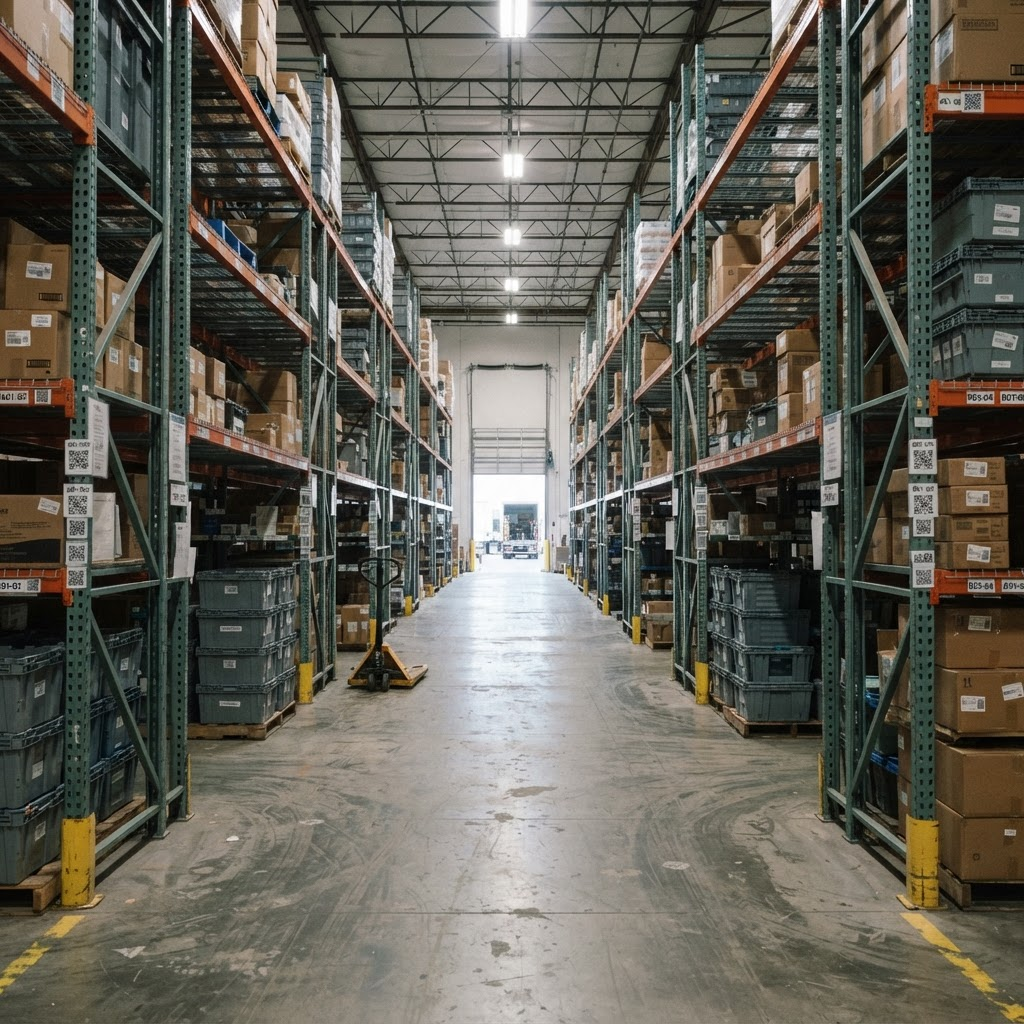
A fulfilment facility interior with racking, conveyor sortation and loading dock doors, seen from the first-person viewpoint of someone working on the floor.
Head-worn capture keeps the hands, the package and the scanner or label in view from the contributor’s own point of view, which is the view a robot working the same station would have.

Requirements

What does scanning and labeling capture need that a generic warehouse clip does not?

01

The hands, the item and the scanner or label in view together

One hand usually steadies the package while the other aims a scanner or lines up a label. First-person capture keeps both hands and the item in frame, and 3D hand pose carries a per-joint visibility flag so a finger hidden behind a scanner body or a label sheet is flagged rather than guessed.

02

A spec that names the step, not just the station

The site’s skill-spec guide says to name the verb and the noun rather than a broad activity. A spec for this family names the task, such as applying and aligning a shipping label or scanning a parcel and sorting it to a lane, and where one completed step starts and ends, so each step can become its own labeled segment.

03

Separate coverage for each scan and label task

The site’s warehouse robotics page says single-item pick, barcode scan, carton break-down, pallet stacking, label application and two-person carry each need their own coverage, not one generic "warehouse" label. The same separation applies inside this family: scanning, printing and applying are different motions.

04

Reject rules written before capture, not after

An item is rejected when the manipulated object is out of frame for too much of the episode, when depth is invalid over too much of the manipulation region, or when an undocumented bystander appears. The thresholds are agreed in the spec, so the batch is judged against terms you signed.

Definition

What is egocentric barcode scanning and labeling data?

Egocentric barcode scanning and labeling data is first-person video of a person scanning codes with a handheld scanner, printing labels, applying shipping, product or asset labels and tagging items, recorded from the contributor’s own point of view with synchronized sensor streams alongside. The camera sits on the head, close to what a robot’s onboard camera would see over a pack bench, a sortation lane or a shelf, so the frames show what the hands do with the scanner, the label and the package rather than a distant view of someone standing near equipment. On this site it is a custom collection: you name the task, the setting and the scanning or labeling steps involved, and capture is run to a written skill spec.

The data is human capture. A paid, consented contributor wears the rig and performs the task. It is not robot or teleoperation data, and it is not a fixed corpus you download. This page is narrower than logistics and fulfillment data, which covers the whole flow from receiving to loading, narrower than warehouse robotics data, which covers the broad warehouse skill set, and narrower than packing and kitting data, which centres on building the order. The subject here is the scan-and-label family of tasks and what the site states about capturing, labeling and checking them.

People reach this topic through close cousins: barcode scanning robot training data, a package labeling video dataset, egocentric scanning task data, or custom logistics labeling data collection. They describe one request from different angles, and the work is the same: write down the task, collect it on demand from real benches, lanes and counters, and receive validated episodes. Nothing on this page states that the video carries decoded barcode values, read label text or a scan result.

Why it matters

Why do robots need first-person video of scanning, printing and applying labels?

NVIDIA’s GR00T N1 paper describes a data pyramid with web data and human video at the base, synthetic data in the middle and real robot trajectories at the top. First-person human video of scanning and labeling work sits in that base layer. Human capture does not replace robot data, and this page does not claim that it does.

Scanning and labeling look simple and are not. The hand that aims a scanner or lines up a label has to bring a small code or a flat sticker to the right place on a package, in a workable orientation, and then move on to the next item. A clip that shows a hand somewhere near a parcel does not carry that. The hands, the item, the scanner or label and the moment of contact all have to be present in the episode, and the episode has to say where one step ends and the next begins.

The site already treats these as separate skills. Its warehouse robotics page says single-item pick, barcode scan, carton break-down, pallet stacking, label application and two-person carry each need their own coverage, not one generic "warehouse" label. Its warehouse picking dataset page lists a barcode scan with a handheld gun and label application and print reconciliation among the skills it describes. This page takes the scan-and-label slice of that list and gives it a dedicated spec, so you can ask for the steps your model is missing instead of hoping a broad warehouse collection happens to contain them.

Breadth across tasks matters as much as volume on one of them. Generalist’s GEN-0 write-up makes a point about data in different words: "data quality and diversity matters more than sheer volume." For scanning and labeling that points at the spread of tasks and settings. Labeling outbound boxes at a pack bench, scanning parcels to lanes in a sortation zone, tagging merchandise on a retail floor and applying an asset tag to a hardware unit are different tasks with different geometry, and a corpus that repeats one station does not cover them. The catalog lists scan and label rows across six sectors, which the task section below sets out.

A custom collection lets you aim at the scan, the print or the apply step and the setting your model is missing. This page does not claim that any particular public corpus lacks scanning or labeling work.

Scanning and labeling tasks

Which scanning and labeling tasks can be captured?

The first table below reproduces twenty rows of the site’s commercial task catalog that name a scanner, a barcode, a label or a tag step. Each is listed with a skill level, a capture setup and a status exactly as the catalog states them. It is a selection, not the whole catalog. Other retail rows, such as checkout and returns, damaged-goods sorting and tagging merchandise with a pricing gun, also mention scanning or labeling, and a few healthcare rows label tubes and specimen containers. They are left out of the table because the scan or label step is one part of a wider task, or because they sit in settings this page does not cover.

In a warehouse and distribution center the catalog lists packing and labeling, scanning, packing and labeling a customer order with a handheld barcode scanner, printing labels and applying them to outbound boxes before sorting by carrier or route, labeling boxes and products by type with a handheld label gun, reconciling shelf counts with a barcode scanner, cycle counting and returns processing. All seven are listed as easy, use a head-mounted phone or multiview rig, and are marked ready to deploy.

The warehouse zone set, which the catalog describes as conveyor, racking, pallets and a pack bench, lists applying and aligning shipping labels, stripping and re-labeling for a re-route at a cross-dock, and scanning parcels and sorting them to lanes. Last-mile delivery and courier work lists scanning and collecting parcels at pickup and drop-off, and scanning parcels at the door. The zone rows use a multiview rig with handheld grippers and the last-mile rows a head-mounted phone or multiview rig, and all five are marked available on request.

Beyond logistics, the table lists applying product and barcode labels in a plastic and light-assembly manufacturer, label and scan rows at an electronics assembly bench and a data center and IT hardware bench, a label-maker row at an office document station, a bag tag scan at a mock security checkpoint, price tagging at a retail back of house, a grocery checkout row, and a pharmacy and laboratory labeling row. The manufacturer labeling row and price tagging are marked ready to deploy, and the others are marked available on request.

The catalog is a list of what is captured or available, not a ceiling on what can be briefed. A code type, label format, scanner style, package type or setting outside these rows is a skill-spec question to settle in a Spec Pilot rather than an assumption. The site does not describe a code symbology, a label size, a scanner model or a carton size for any of these rows, so none is stated here.

Capture setup

What capture setup and streams are used?

A scanning and labeling collection uses the same capture stack as every Firsthand program. The instrumented tier is a head-mounted stereo rig that records first-person RGB, with a metric depth stream recovered from the calibrated stereo rig rather than from a standalone depth sensor, and 6-DoF IMU data at 200 Hz from head- and wrist-mounted sensors. The wider stack is ten streams: a 4K head camera, two wrist cameras, depth, IMU, 3D hand and body pose, instance segmentation and action labels, hardware-aligned under 2 ms. The two wrist cameras give a second, closer view of the hands than the head camera alone, which matters when a hand closes around a scanner grip or peels a label from its sheet.

Every stream is hardware-triggered onto one PTP clock domain, so depth, motion and hand pose line up with the same video frame rather than being approximated afterwards. The rig is calibrated twice per session, before capture starts and after it ends, and an episode is accepted only if RMS reprojection stays under 0.28 px. The catalog lists the capture setup per task: a head-mounted phone or multiview rig for the warehouse, last-mile, manufacturing, retail, grocery and pharmacy rows, and a multiview rig with handheld grippers for the warehouse zone, bench, asset-tag, office and checkpoint rows. Which tier applies to your program is set in the skill spec.

On depth, the site states a limit for small parts: small fasteners can fall below a depth sensor’s reliable floor, so metric depth on sub-centimetre parts is flagged rather than interpolated, while hand pose stays valid at that range. That statement is about small fasteners and parts. The site does not state how depth behaves on a flat adhesive label or a printed code, and it does not state at what distance a printed code or label text can be read in the head or wrist frames, so this page does not either. Force and tactile readings are not among the streams, and no robot or teleoperation data is captured.

Labels

Which labels and annotations are available?

Each attempt is delivered as one episode. Inside it, action segments divide the episode into start- and end-timestamped spans, each carrying start_ns, end_ns, verb and noun. For this task family a segment can be one step as written in the skill spec, so a pack-out becomes a sequence of labeled steps such as scan, print, apply and sort rather than one long clip. The other standard fields are hand_joints and hand_visible for 3D hand pose, contact_events for the moment the hand meets the item, objects, and instance_masks, stored at the depth resolution of 848×480 so they line up with the depth stream.

Hand pose is delivered for both hands with a per-joint visibility flag for occluded fingers. That is the label that carries the two-handed structure of scanning and labeling: where the hand that steadies the package sits relative to the hand that aims the scanner or smooths the label. Contact events mark when a hand meets the package, the scanner or the label, and action segments mark where one step ends and the next begins.

Masks need a spec decision. The site states that clothing, bedding and bags do not track well with masks propagated frame to frame, so deformable captures ship per-frame instance masks where the spec calls for them. Bags are named in that statement; whether a given package type needs per-frame masks is settled in the spec.

The site does not list labels for the content or the outcome of a scan. There is no stated label for a decoded barcode value, recognised label text, a successful or failed scan, a correctly placed label, a tracking or order number, a scan rate or a throughput figure. Several catalog task descriptions mention checking, verifying or reconciling, but that describes the task the contributor performs, not a delivered measurement.

Stated limits

What does the site state about the hard parts of recording scanning and labeling work?

Several limits the site already states apply directly to scanning and labeling capture, and several it leaves open. Each stated limit below appears elsewhere on the site rather than being introduced here.

Hand occlusion is the first. Fingers disappear behind objects in manipulation, which is why 3D hand pose carries a per-joint visibility flag. A hand closing around a scanner grip or covering a label is an everyday case here. The second is depth on small parts, covered above: metric depth on sub-centimetre parts is flagged, not interpolated. The third is masks, where per-frame instance masks are the stated answer for items that do not track well when propagated, and the spec is where you decide whether a package type needs them.

The fourth is the set of machine-checked reject criteria. An episode is rejected for a sync breach beyond the ceiling for more than three consecutive frames, calibration drift beyond tolerance, the manipulated object out of frame for more than 15 percent of the episode, more than 35 percent invalid depth pixels in the manipulation region, an undocumented bystander, or a mismatch against the named skill spec. A human reviewer then checks each episode against the task spec.

What the site does not state is just as useful to know before you scope. It gives no depth behavior for a flat label or a printed code, no distance at which a code or label text is readable, no mask accuracy figure for parcels, no label-placement or scan-success annotation, and no description of how glare or reflective packaging is handled. If your policy depends on any of those, say so at the start.

QA, consent and safety

How do QA, consent, safety and anonymization apply?

Validation runs against signed accept criteria written into the spec before capture. Each batch goes through per-batch QA and a reject log ships with it. Only footage that clears the criteria is billed as a validated hour, and rejected items are recaptured at our cost. Many teams start with a Spec Pilot, a small, fast first batch that proves the spec and the accept criteria on real footage before volume scales.

Every contributor signs a written release before capture, and each delivered episode links to that record through consent artefact IDs in the batch data card. The consent chain has six checkpoints, from before capture to after delivery, and a break at any one discards the footage rather than shipping it at a lower grade. At capture, site permission is on file. At ingest, automated detection finds faces, plates and screens and blurs them irreversibly, and speech is scrubbed of names, addresses and card numbers while ambient audio is kept. A human reviewer confirms that no un-consented person is identifiable in any frame, and footage that cannot be de-identified is discarded. The anonymization record is delivered with the data. The site also states that capture does not take place at a customer’s own facility, and it does not state whether buyer-supplied packaging or label stock can be used, so raise that in the spec.

Labels need a plain statement. The site states that parcel and shipping labels, tote labels, carton markings, mail and barcodes are not listed as blur categories, so this page does not claim they are blurred. The listed categories are faces, plates and screens. If text on items or label content in frame matters for your use, raise it in the spec so the handling is agreed before capture rather than assumed afterwards. Labels and parcels that carry personal details are a particular reason to do that.

On safety and qualification, the site states no contributor safety protocol and no safety certification for any scanning or labeling row, and this page does not describe one. If your program needs terms about who performs the work, the equipment involved or the conditions under which it is done, raise them when you scope it. None of this is legal advice, and the executed agreement controls.

Delivery and speed

How fast can a custom scanning and labeling dataset be delivered?

From signed spec to first validated batch, the timeline is a median of 48 hours where coverage is deep and three to four weeks where it is thin and contributors need to be recruited first. Speed comes from a warm pipeline, not from cutting consent, review or anonymization. After the first batch, on-demand top-ups run against the same accept criteria, so you can add more tasks, settings or variation without rewriting the spec. The site does not state a turnaround for those later batches, so plan them in your quote.

Delivery is in the format your stack already reads: RLDS, LeRobot, WebDataset, HDF5, zarr or Rerun .rrd, or raw streams with metadata. Readable converter source ships alongside the data so the schema can be retargeted to your own loader. Collections are billed per validated hour.

The license is perpetual, irrevocable and worldwide, with the data buyer-owned and non-exclusive by default. Training, evaluating, fine-tuning and deploying models, including commercial ones, is permitted, and exclusivity is available as a separate term. The executed agreement controls. The site does not publish a price list, a minimum order or a batch size for this task family, so those are set in your quote.

Not stated

What does a scanning and labeling collection not include?

Where this site does not state something, this page says "not stated" rather than filling the gap. The table below separates what is delivered from what is not stated. There is no listed label for a decoded barcode, recognised label text, scan success, label placement or a tracking number, no scan rate or throughput figure, no force or tactile stream, and no code type, label size or scanner model. Nothing here claims a training outcome or a model improvement.

The tradeoff to plan for is the embodiment gap between a human hand and a robot end-effector, which retargeting or pairing with robot data has to close. Counts of stations, contributors, hours and tasks are set in your skill spec.

Getting started

How do you scope and request a custom scanning and labeling dataset?

Describe the scanning, printing or labeling tasks, the setting, the package types and the variation or failure cases your pipeline is missing. That becomes a written skill spec, quoted for reach, timeline and price before any capture begins, and most programs run a Spec Pilot first. The scoping checklist below maps the parts of a skill spec onto a scan-and-label request. A published sample recording is on the sample data outputs page if you want to see the streams before you write a spec.

Three choices matter most for this family. Name the step and the item rather than a broad activity, because that is what lets each step become one action segment. Name the setting and the capture tier, since a pack bench, a sortation lane and a retail counter present different geometry and the catalog lists a different capture setup for them. And name the lighting and participant mix: daylight coverage fills fastest, while evening, low-light capture is the harder cell to fill.

Capture setup

What is the capture setup for a scanning and labeling collection?

The capture setup as stated on this site, applied to scanning and labeling work. Counts of stations, contributors and hours are set in the skill spec.
PartAs stated on this site
Instrumented rigHead-mounted stereo rig worn by the contributor; first-person RGB
StreamsTen: 4K head camera, two wrist cameras, depth, IMU, 3D hand and body pose, instance segmentation, action labels
SyncHardware-triggered onto one PTP clock domain; aligned under 2 ms
DepthMetric depth recovered from the calibrated stereo rig; metric depth on sub-centimetre parts flagged rather than interpolated
IMU6-DoF at 200 Hz from head- and wrist-mounted sensors
CalibrationTwice per session; accepted only under the 0.28 px RMS reprojection gate
MasksPer-frame instance masks where the spec calls for them, stored at 848×480
Catalog capture setupHead-mounted phone or multiview rig for warehouse, last-mile, manufacturing, retail, grocery and pharmacy rows; multiview rig with handheld grippers for warehouse zone, bench, asset-tag, office and checkpoint rows

Every collection runs through the same seven-stage end-to-end custom collection pipeline.

Task variations

Which scanning and labeling tasks does the catalog name, and what is captured?

Twenty catalog rows that name a scanner, barcode, label or tag step, reproduced as the catalog states them. Where a row has no separate description, the catalog’s environment note is shown in its place. The selection is not the whole catalog.
Task (as listed)Description (as listed)EnvironmentSkill levelCapture setupStatus
Packing & LabelingPack orders into boxes with filler, tape them shut and apply the shipping label.Warehouse & Distribution CenterEasyPhone (head-mounted) / multiview rigReady to deploy
Pick, scan, pack, and label customer orders using a handheld barcode scanner and a tape gun.Fulfillment warehouse with racked storage aisles, picking carts, and packing benches.Warehouse & Distribution CenterEasyPhone (head-mounted) / multiview rigReady to deploy
Sort and label outbound boxes using a label printer and box cutterPrint labels, apply them to outbound boxes and sort the boxes by carrier or route.Warehouse & Distribution CenterEasyPhone (head-mounted) / multiview rigReady to deploy
Sort, separate, and label boxes and products by type using a handheld label gun and sorting carts.Warehouse with racked storage, sorting stations, and dedicated labeling benches.Warehouse & Distribution CenterEasyPhone (head-mounted) / multiview rigReady to deploy
Count and reconcile shelf inventory using a barcode scanner and count sheetsScan shelf locations, count items and record the totals on the count sheet.Warehouse & Distribution CenterEasyPhone (head-mounted) / multiview rigReady to deploy
Cycle Counting & InventoryCount stock in assigned locations with a scanner and reconcile the numbers against the system.Warehouse & Distribution CenterEasyPhone (head-mounted) / multiview rigReady to deploy
Returns ProcessingOpen returned parcels, inspect and scan items and route them to restock or disposal.Warehouse & Distribution CenterEasyPhone (head-mounted) / multiview rigReady to deploy
Apply shipping labelsApply and align shipping labels.Warehouse Zone (conveyor, racking, pallets, pack bench)EasyMultiview rig + handheld grippersAvailable on request
Cross-dock re-labelStrip and re-label for re-route.Warehouse Zone (conveyor, racking, pallets, pack bench)EasyMultiview rig + handheld grippersAvailable on request
Scan + sort parcelsScan parcels and sort to lanes.Warehouse Zone (conveyor, racking, pallets, pack bench)EasyMultiview rig + handheld grippersAvailable on request
Courier pickup and drop-offScan and collect parcels at pickup, load the vehicle and hand them over at drop-off.Last-Mile Delivery & CourierEasyPhone (head-mounted) / multiview rigAvailable on request
Parcel deliverySort parcels in the van, carry them to the door, scan and hand them to the recipient.Last-Mile Delivery & CourierEasyPhone (head-mounted) / multiview rigAvailable on request
LabelingApply product and barcode labels to units or cartons by hand or with a label gun.Plastic & Light-Assembly ManufacturerEasyPhone (head-mounted) / multiview rigReady to deploy
Label + scan unitApply a barcode label and scan.Precision Assembly Bench (electronics)EasyMultiview rig + handheld grippersAvailable on request
Apply + scan asset tagLabel a unit and scan the barcode.Data Center & IT Hardware BenchEasyMultiview rig + handheld grippersAvailable on request
Label-maker + applyPrint and apply labels to items.Office Document StationEasyMultiview rig + handheld grippersAvailable on request
Baggage tag scanScan a bag tag and route.Mock Security CheckpointEasyMultiview rig + handheld grippersAvailable on request
Price Tagging & SignagePrint price labels, tag merchandise with a pricing gun and place shelf signage.Retail Store -- Back of HouseEasyPhone (head-mounted) / multiview rigReady to deploy
Checkout and baggingScan items, take payment, bag groceries by weight and hand them to the customer.Grocery & SupermarketEasyPhone (head-mounted) / multiview rigAvailable on request
LabelingPrint and apply labels to tubes, bottles and dispensed medication and check them.Pharmacy & LaboratoryEasyPhone (head-mounted) / multiview rigAvailable on request

Streams and labels

Which streams and labels are delivered for scanning and labeling work, and which are not stated?

Delivered items are stated elsewhere on this site. Items marked not stated are not promised on this page.
Stream or labelWhat it gives a scanning or labeling episodeStatus
Head and wrist camerasFirst-person view of the task plus a closer view of the handsDelivered
DepthStation and package geometry; metric depth on sub-centimetre parts is flagged, not interpolatedDelivered
6-DoF IMU at 200 HzHead and wrist motion aligned to the video frameDelivered
3D hand pose with per-joint visibility flagsBoth hands across the step; occluded fingers flaggedDelivered
Contact eventsThe moment the hand meets the package, scanner or labelDelivered
Action segments (start_ns, end_ns, verb, noun)One labeled span per stepDelivered
Per-frame instance masks (848×480)Item masks where the spec calls for themDelivered where specified
Consent artefact IDs and anonymization recordProvenance per episodeDelivered
Decoded barcode value or recognised label textNot listedNot stated
Scan-success or label-placement annotationNot listed; catalog verbs such as scan, check and reconcile describe the task onlyNot stated
Tracking or order number annotationNot listedNot stated
Scan rate or throughput figureNot listedNot stated
Blurring of labels, barcodes or carton markingsNot listed as blur categories; the site states faces, plates and screensNot stated
Force or tactile readingsNot among the listed streamsNot stated
Robot or teleoperation dataHuman first-person demonstrations onlyNot captured
Counts of stations, contributors, hours and tasksSet per program in the skill specNot stated

Scoping checklist

What does a scanning and labeling request put into each part of a skill spec?

The parts of a skill spec as the site’s guide describes them, applied to a scan-and-label request. The catalog wording is quoted where it helps; your own fields and numbers are agreed with you.
Skill-spec partWhat to name for a scanning or labeling requestDrawn from what the site states
Named skillThe verb and the noun: the scan, print or apply step and the item, not "warehouse work"Catalog wording such as "Apply and align shipping labels"
Geometry that must be visibleWhat must be in frame and for how long: both hands, the package, the scanner or label sheetSet in the skill spec
Condition budget in hoursHours per condition cell, including failure cases and the settingsSet per program in the skill spec
Reject ruleThe conditions that fail an item, written firstObject out of frame for more than 15 percent of the episode; more than 35 percent invalid depth pixels in the manipulation region; an undocumented bystander
Acceptance testOne test that decides whether an attempt counts as completeYour acceptance test is agreed in the spec
Setting and capture tierPack bench, lane, retail counter or asset bench, and phone or multiview rigThe catalog lists a capture setup per row
Label and text handlingWhether text or codes on items in frame need special handlingNot listed as blur categories; agreed in the spec rather than assumed
Participants and lightingHandedness, technique and pace; daylight or low lightSet per program in the skill spec

FAQ

Egocentric barcode scanning and labeling video data, answered.

What is egocentric barcode scanning and labeling video data?
Custom first-person video of people scanning items and parcels, printing labels, applying package labels and tagging goods, captured by paid, consented contributors wearing a capture rig and doing the tasks in a written skill spec, and delivered with synchronized streams, hand pose, action segments and consent and anonymization records.
Which scanning and labeling tasks does Firsthand capture?
The site’s task catalog names packing and labeling, scanning and labeling customer orders with a handheld barcode scanner, printing and applying labels to outbound boxes, applying and aligning shipping labels, scanning parcels to lanes, inventory counts with a scanner, and product, asset and price labeling, among others. Anything else is settled in the skill spec and a Spec Pilot.
What streams and labels come with a scanning or labeling episode?
Ten hardware-synchronized streams, including head and wrist cameras, depth, IMU, 3D hand pose and instance segmentation, plus action segments with start_ns, end_ns, verb and noun, hand pose with visibility flags and contact events.
Do you provide decoded barcode, label text or scan-success labels?
Not stated. The delivered fields are action segments, 3D hand pose with visibility flags, contact events, objects and instance masks where the spec calls for them. No decoded barcode value, recognised label text, scan-success, label-placement, tracking number, scan rate or throughput data is listed.
Are barcodes and shipping labels blurred in the footage?
The site states that faces, plates and screens are detected and irreversibly blurred and reviewer-confirmed. Parcel and shipping labels, carton markings and barcodes are not listed as blur categories, so no blurring of them is claimed. If text or codes in frame matter for your use, agree the handling in the spec before capture.
How is a scanning and labeling dataset checked before delivery?
Episodes are machine-checked against reject criteria written into the spec, such as the object out of frame for more than 15 percent of the episode or more than 35 percent invalid depth pixels, then reviewed by a human against the task spec. A reject log ships with each batch, and only footage that clears the criteria is billed as a validated hour.
How fast can a custom scanning and labeling dataset arrive?
A median of 48 hours from signed spec to first validated batch where coverage is deep, and three to four weeks where it is thin. The site does not state a turnaround for later top-up batches.
Who owns the data, and what formats are offered?
The buyer owns the delivered data under a perpetual, irrevocable, worldwide, non-exclusive commercial license by default, with exclusivity available as a separate term. Delivery is in RLDS, LeRobot, WebDataset, HDF5, zarr or Rerun .rrd, or raw streams with metadata.
Sources

Where are these scanning and labeling capture claims documented?

Request a custom scanning and labeling dataset.

Tell us the scanning, printing or labeling tasks, the settings and the package types your model needs to see. We will quote reach, timeline and price against a written spec, with a first validated batch in a median of 48 hours where coverage is deep.