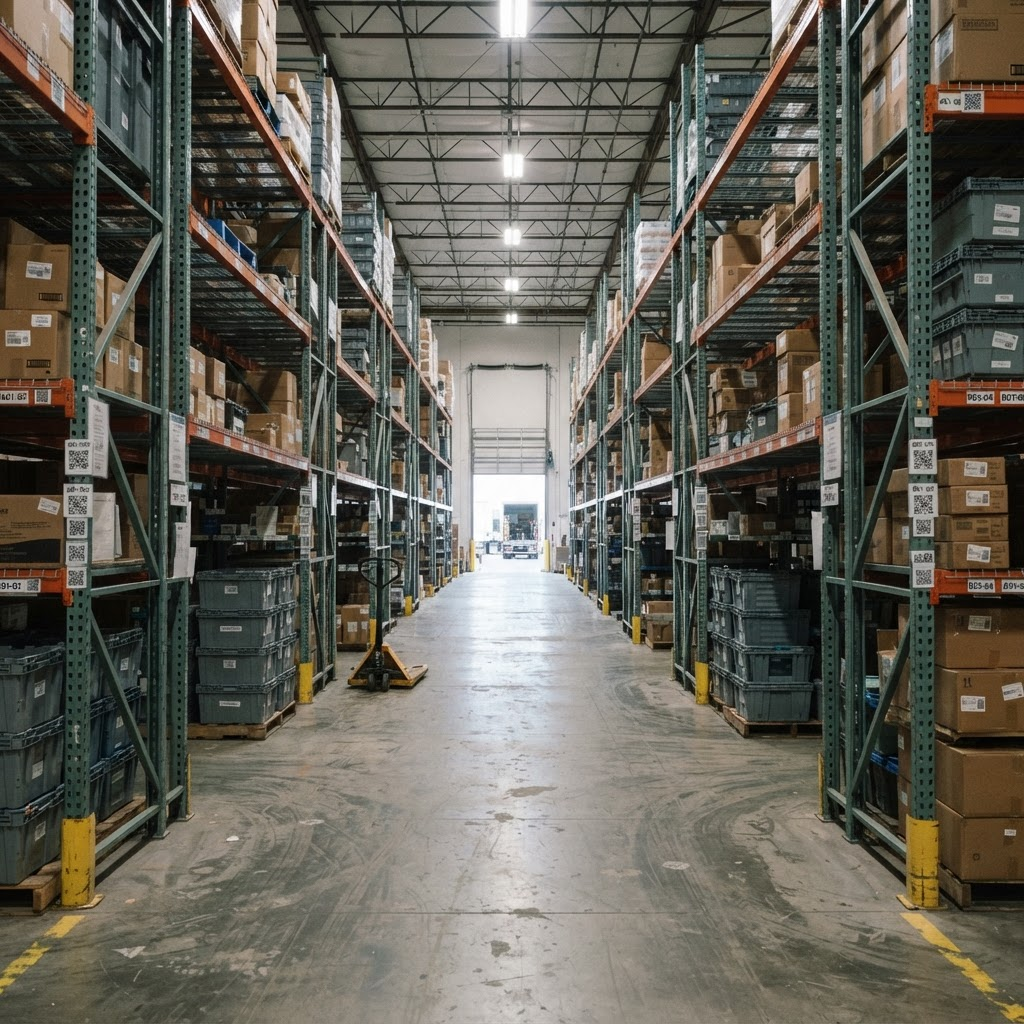
Captured on shift, not staged
Live fulfilment space has mixed lighting, multi-person traffic, and real failure cases mis-picks, dropped totes, jams that a mock aisle never reproduces.
Warehouse & logistics
Requirements
Live fulfilment space has mixed lighting, multi-person traffic, and real failure cases mis-picks, dropped totes, jams that a mock aisle never reproduces.
Single-item pick, barcode scan, carton break-down, pallet stacking, label application, and two-person carry each need their own coverage, not one generic "warehouse" label.
Pick aisles have long sight-lines. Distance-invalid pixels beyond reliable depth range are flagged rather than interpolated, so you know exactly where the depth stream stops being trustworthy.
A perpetual, buyer-owned commercial license backed by a documented consent chain, so a policy trained on the data can go into a product.
Why it matters
Incidental warehouse footage in public corpora is unsynchronized across streams and carries no manipulation-grade hand pose, because it was never captured against a named pick-and-pack skill list in the first place.
Live fulfilment space also means mixed sodium and daylight lighting, cabling routed under hi-vis PPE that shifts wrist extrinsics, and genuine multi-person traffic — all of which change how a rig has to be run and recalibrated session to session.
Capture setup
A head-mounted camera keeps the pick, scan, and place motion in frame from the viewpoint a warehouse policy will actually see from, through pick aisle, pack bench, pallet build, and returns desk work.
Depth, hand pose, and action segments are aligned to video on one hardware clock. Per-session recalibration accounts for cabling routed under PPE, and long sight-lines beyond reliable depth range are flagged rather than interpolated.
The spec
You describe the pick-and-pack tasks your policy needs. We turn it into a written spec covering tasks, environments, capture tier, annotation depth, and accept criteria, then quote reach, timeline, and price against that document before any capture begins.
The collection runs through the same seven-stage end-to-end custom collection pipeline as every Firsthand program: contributor recruiting, capture, per-batch QA, anonymization, and licensed delivery. Rejected items are recaptured at our cost.
Fast · on demand
Where coverage is already deep, the first validated batch lands in a median of 48 hours from signed spec. Thin environments typically take three to four weeks, because vetting operators there is the bottleneck, and we quote that timeline up front.
On-demand top-ups run against the same spec and accept criteria after each training run, so new warehouse data stays consistent with what you already hold.
Rights
Every custom collection ships under a perpetual, buyer-owned commercial license, and exclusivity is available so the data is never resold. Each episode links to a signed contributor release through a documented consent chain.
Faces, plates, and screens are detected and irreversibly blurred at ingest, and a reviewer confirms the result before anything ships. The anonymization record is delivered with the data.
Warehouse task vs delivery
| Warehouse robotics need | What Firsthand captures |
|---|---|
| Pick and place in frame | Head-mounted camera keeping the pick, scan, and place motion visible through the task cycle |
| Named skill coverage | Single-item pick, barcode scan, carton break-down, pallet stacking, label application, two-person carry |
| Hand-level detail | 3D hand pose tracked through reach, grasp, and place |
| Depth at range | Synchronized depth stream, with distance-invalid pixels beyond reliable range flagged rather than interpolated |
| Action structure | Instance segmentation, action segments, grasp and contact events |
| Quality | Measured against signed accept criteria; billed per validated hour; reject log with every batch |
| Formats | RLDS, LeRobot, WebDataset, plus HDF5, zarr, and Rerun .rrd |
Every collection runs through the same seven-stage end-to-end custom collection pipeline.
FAQ
Sources
Tell us the pick-and-pack tasks your policy needs to perform. We will quote reach, timeline, and price against a written spec, with a first validated batch in a median of 48 hours where coverage is deep.