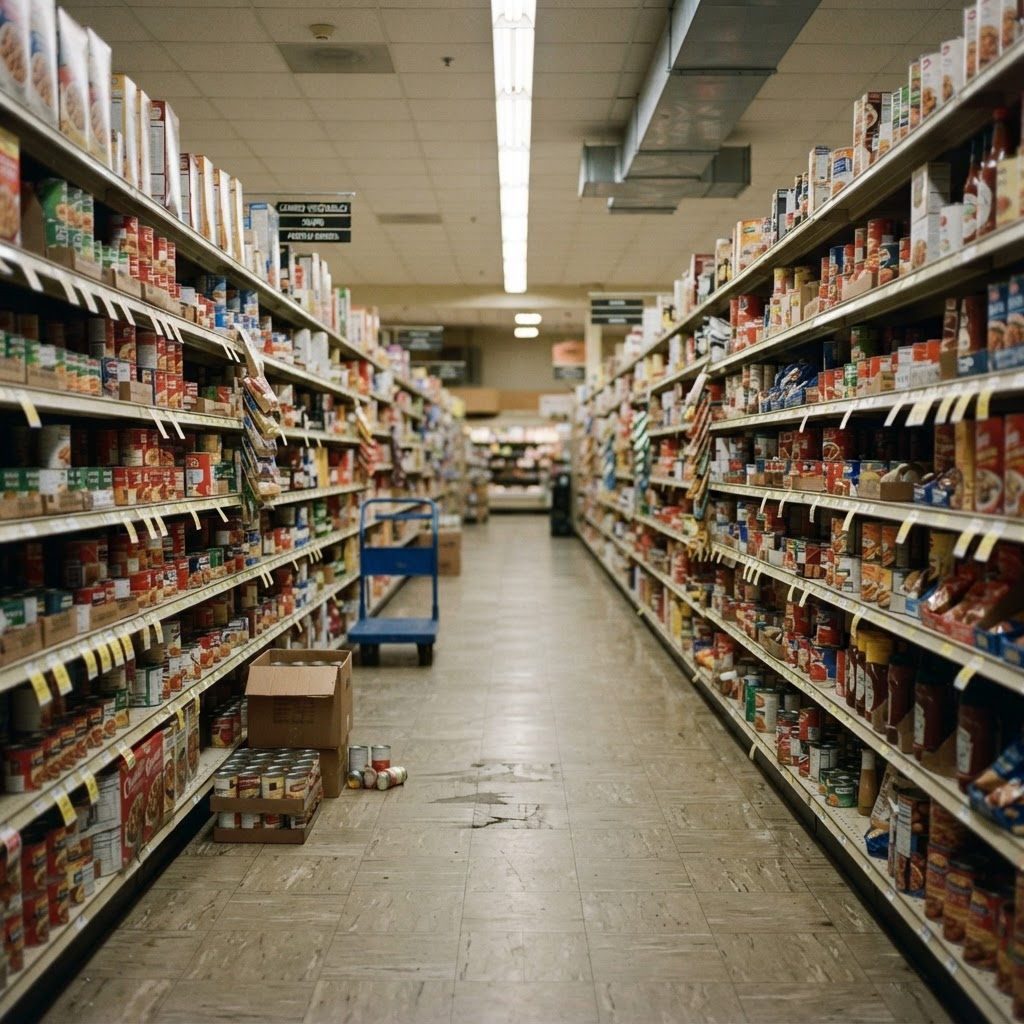
Captured on the live floor, not staged
A working retail aisle has bystanders, mixed store lighting, and real edge cases like a part-emptied case or a mis-faced shelf, none of which a mock aisle reproduces.
Retail & shelf ops
Requirements
A working retail aisle has bystanders, mixed store lighting, and real edge cases like a part-emptied case or a mis-faced shelf, none of which a mock aisle reproduces.
Facing, case-cut and shelf-load, price and label swap, chilled-case rotation, and fixture reset each need their own coverage, not one generic "retail" label.
Shelf work happens close to the body. Depth and 3D hand pose need to hold through reach, grasp, and place at that range, aligned to video on one hardware clock.
Bystanders and other shoppers appear in frame on a live retail floor. Faces, plates, and screens need to be detected and irreversibly blurred before anything ships.
Why it matters
A robot that stocks, faces, or picks on a retail floor needs to learn the same reach and grasp geometry a person uses from that viewpoint, not a description of the task or a fixed-camera view of someone else doing it.
That means synchronized egocentric video, depth, 3D hand pose, and frame-accurate action segments, captured against a named list of shelf-ops skills rather than pulled from incidental footage never meant for manipulation training.
Task coverage
A custom retail collection is scoped to the shelf-ops skills your policy needs: facing and fronting stock to a planogram, case-cut and shelf-load, price and label swap, chilled-case rotation by date code, and hanger or fixture reset.
You describe which of these tasks (and which store formats — grocery aisle, chilled case, apparel fixture, back-of-house staging) your policy needs, and the collection is scoped to that list rather than a generic retail category.
Capture setup
A head- and wrist-mounted camera keeps the facing, restocking, and picking motion in frame from the viewpoint a retail policy will actually see from, across grocery aisle, chilled case, apparel fixture, and back-of-house staging.
Depth, hand pose, and action segments are aligned to video on one hardware clock, so a policy fusing vision with depth or hand pose is training on streams that share the same timeline, not software-timestamped video stitched together after the fact.
Delivery
Each episode ships with 3D hand pose tracked through reach, grasp, and place; instance segmentation; action segments; and grasp and contact events, alongside the synchronized video and depth streams.
Delivery formats are RLDS, LeRobot, and WebDataset, plus HDF5, zarr, and Rerun .rrd, with readable converter source so you can retarget the schema to your own loader.
Rights
Every custom collection ships under a perpetual, buyer-owned commercial license, and exclusivity is available so the data is never resold. Each episode links to a signed contributor release through a documented consent chain.
Because a live retail floor has bystanders and other shoppers in frame, faces, plates, and screens are detected and irreversibly blurred at ingest, and a reviewer confirms the result before anything ships. The anonymization record is delivered with the data.
Custom vs existing
The existing retail shelf stocking dataset is a fixed, already-captured corpus: a defined hour count, a defined set of skills and store formats, available now under its published terms.
A custom collection is scoped to your written spec instead — the exact skills, store formats, and accept criteria your policy needs, captured on demand rather than chosen from a fixed catalog. If the existing dataset already covers your task list, it ships faster; if it does not, a custom collection fills the gap without waiting on a future dataset release.
Getting started
You describe the shelf-ops tasks and store formats your policy needs. We turn it into a written spec covering tasks, environments, capture tier, annotation depth, and accept criteria, then quote reach, timeline, and price against that document before any capture begins.
A Spec Pilot is a small, fast first batch that proves the spec and accept criteria before you scale volume on demand, running through the same seven-stage end-to-end pipeline as every Firsthand program: contributor recruiting, capture, per-batch QA, anonymization, and licensed delivery.
Capture setup
| Retail robotics need | What Firsthand captures |
|---|---|
| Facing and picking motion in frame | Head- and wrist-mounted camera keeping the facing, restock, and pick motion visible through the task cycle |
| Named skill coverage | Facing and fronting, case-cut and shelf-load, price and label swap, chilled-case rotation, hanger and fixture reset |
| Hand-level detail | 3D hand pose tracked through reach, grasp, and place |
| Synchronized depth | Depth stream aligned to video and hand pose on one hardware clock |
| Action structure | Instance segmentation, action segments, grasp and contact events |
| Quality | Measured against signed accept criteria; billed per validated hour; reject log with every batch |
| Formats | RLDS, LeRobot, WebDataset, plus HDF5, zarr, and Rerun .rrd |
Every collection runs through the same seven-stage end-to-end custom collection pipeline.
Task coverage
| Retail task | What's captured | Labels delivered |
|---|---|---|
| Face and front stock to a planogram | Reach, grasp, and reposition of product on shelf | Action segments, 3D hand pose, grasp events |
| Case-cut and shelf-load | Opening a case and loading product onto shelf | Action segments, hand pose, contact events |
| Price and label swap | Removing and applying shelf labels | Action segments, hand pose, instance segmentation |
| Chilled-case rotation by date code | Front-to-back stock rotation in a chilled case | Action segments, hand pose, depth |
| Hanger and fixture reset | Rearranging apparel on a fixture | Action segments, hand pose, instance segmentation |
Custom vs existing
| Existing retail shelf stocking dataset | Custom retail collection | |
|---|---|---|
| Skill and store-format coverage | Fixed set already captured | Scoped to your written spec |
| Availability | Available now | Median 48 hours where coverage is deep; three to four weeks where thin |
| License terms | Published dataset terms | Perpetual, buyer-owned; exclusivity available |
| Best fit | Your task list matches its existing skill and environment coverage | Your task list needs skills, stores, or volume the existing dataset does not cover |
FAQ
Sources
Tell us the shelf-ops tasks your policy needs to perform. We will quote reach, timeline, and price against a written spec, with a first validated batch in a median of 48 hours where coverage is deep.