Many objects in one episode
A rearrangement episode moves several objects, so the spec names the full arc: the start state, the moves and the goal arrangement, not one isolated grasp.
Task family
Requirements
A rearrangement episode moves several objects, so the spec names the full arc: the start state, the moves and the goal arrangement, not one isolated grasp.
Contact events on grasp and release, and action segments with start and end to the frame, mark each move inside a long sequence.
Instance masks on manipulated objects and target surfaces, with tracked IDs across the episode, keep each object recognizable from the first touch to the last placement.
Household episodes ship per-frame instance masks for deformable objects, because clothing, bedding and bags do not track well with propagated masks.
A perpetual, buyer-owned commercial license backed by a documented consent chain.
Definition
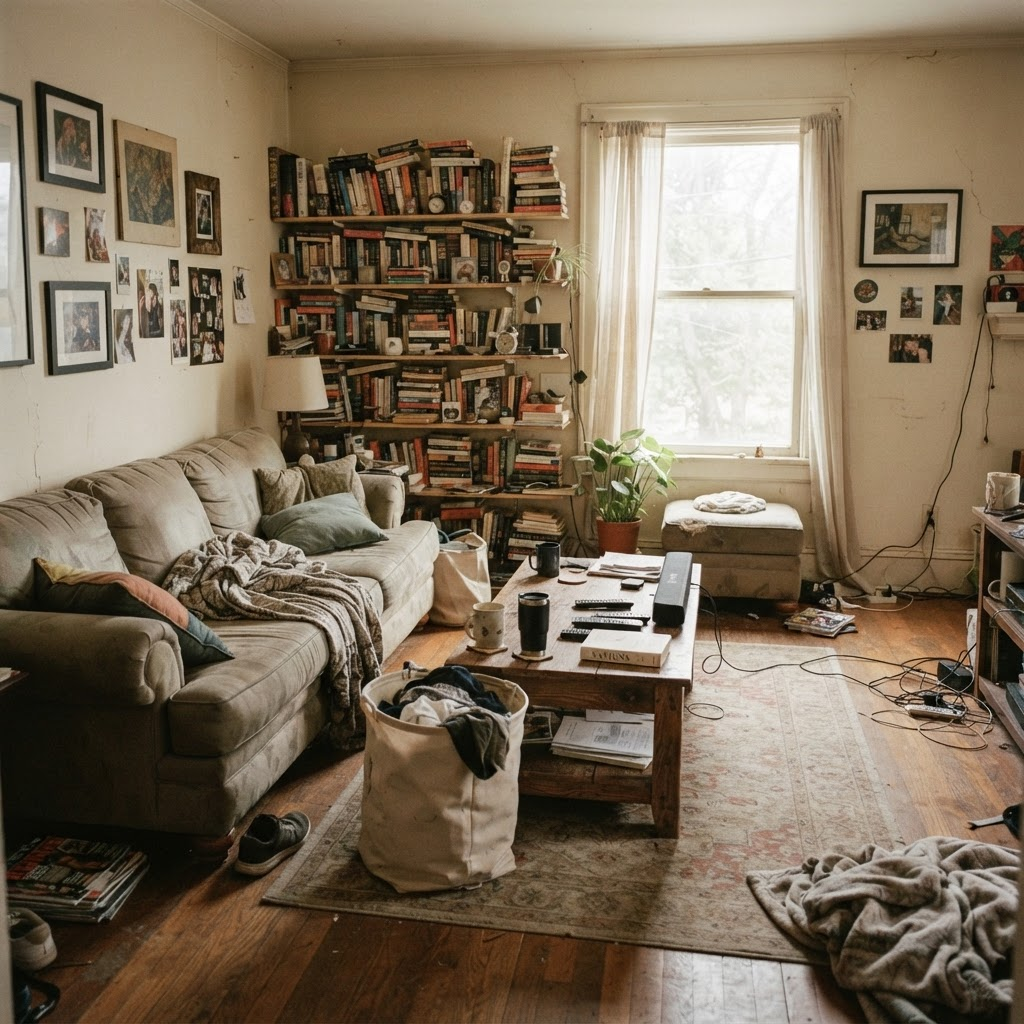
Object rearrangement is the task of changing a scene from one arrangement of objects to another. A person or a robot moves several objects, one at a time or in groups, from their current positions to target positions, and the task is finished when the scene matches the target arrangement. Tidying is the everyday form of it: the target is a conventional arrangement, such as items in their storage place, objects on a shelf in order or a surface cleared, rather than a set of coordinates.
Rearrangement and tidying data is a recording of that work together with the signals a policy learns from: where the hands go, which object is being handled, when contact is made and broken, and how the task divides into steps. This page treats rearrangement as a task family and says plainly which labels the Firsthand site states and which it does not.
Why a separate page
The site already has neighbouring pages, and each is organized by a different axis. Egocentric pick and place data is one manipulation primitive: reach, grasp, transport and place of an object. Egocentric tabletop manipulation data is a capture setting: one bounded work surface. In-home data collection and household robot pretraining data are organized by setting and training stage, and both list tidying as one chore among laundry, cleaning and surface reset.
Rearrangement is the task family that cuts across all of them. It is built from many pick-and-place actions chained over many objects, it can run on a tabletop, a shelf, a rack or a whole room, and it is defined by its end state as much as by its motions. The questions it raises are its own: what the goal arrangement is, how many objects an episode moves, in what order, and how an object stays identifiable from the first touch to the last placement. The first table sets the pages side by side.
Task families
The site does not publish a rearrangement-specific task list, so this page points to the tasks it already describes and names where each comes from. In the household setting, the chores dataset lists surface wipe and clutter reset among its six stated tasks, and the in-home page describes household tasks as long-horizon, low-precision and navigation-heavy.
Outside the home, the task catalog behind the environments hub lists tasks in the same family: re-hanging and tidying a fitting room, tidying and resetting a care room, preparing a room, and returning weights to a rack in order. The retail page lists rearranging apparel on a fixture. The second table sets these out. Each catalog row carries a sector, environment, task, description, skill level, capture setup and status. A listing is a scoping aid, not a statement that the task has been captured.
Goal state
A rearrangement task has a start state, a sequence of moves and a goal state. In tidying the goal is usually implicit: a person knows where things belong, so a spec has to say it in words. The site states that every skill spec names the tasks, the setting, the object set, the capture tier, the annotation depth and the accept criteria, and that a pick-and-place spec is scoped by describing the objects, the start and goal locations and the setting.
The site states no goal-state label, no before-and-after scene capture and no scene-reset protocol. What it does state is how an episode is bounded: action segments carry start and end to the frame, and every batch is validated against signed accept criteria. Writing the start state and the goal arrangement into the spec is therefore a sensible item for the brief, and anything stronger, such as an image of the target arrangement or a list of target positions, is a conversation to have per program. The table headed “What does the site state about rearrangement data?” marks each of these as stated or not stated.
Long-horizon
Rearranging a room is many small actions. Each object is its own reach, grasp, transport and place, and the episode adds decisions on top: which object next, where it goes, and whether to move one thing to reach another. That makes episodes longer than a single-primitive clip, and it is why the site frames household tasks as long-horizon and navigation-heavy rather than as single grasps.
That has three consequences for the data. The episode has to be segmented, so a model can see each sub-action and its order. The data has to span many objects and scenes, because a guide on this site notes that tidying a counter full of different items needs more object and scene diversity than a task on one consistent object. And the whole arc has to be captured, because the in-home spec names the full arc and the rooms it passes through.
Labels
Every Firsthand custom collection uses the same streams and labels, and the third table lists them for this task family. Hand pose is 21 keypoints per hand in 3D with a per-joint visibility flag, and body pose is 24 joints. Contact events mark grasp and release. Action segments use a verb and noun taxonomy of 97 verbs and 512 nouns, with start and end to the frame, human-reviewed.
In a rearrangement episode, contact events give the boundary of each pick and each place, action segments give the structure of the whole sequence, and hand pose carries how each object was held. Which verbs and nouns a rearrangement spec uses is set per program; the site does not list a rearrangement vocabulary.
Object identity
Rearrangement is the task where the object matters most, because the same hand motion moves a mug or a book and the policy has to know which. The site states instance masks on manipulated objects and target surfaces, with tracked IDs across the episode, linked to an objects list and to contact events. A guide on this site adds that a spec attaches instance masks where object identity matters to the policy, and leaves them out where it does not.
Object pose, a scene graph and an explicit category label per object are not stated on the site, and this page does not claim them. If your policy needs object pose or a structured description of the scene, say so in the brief; whether and how it is attached is confirmed per program.
Capture setup
The rig is worn by the contributor. The site states a head-mounted global-shutter camera at 3840 × 2160 and 60 fps with a 120° horizontal field of view, two wrist-mounted cameras at 1920 × 1080 and 60 fps with a 100° horizontal field of view, a depth stream with a per-frame confidence map, and a 6-DoF IMU at 200 Hz. The ten streams are hardware-triggered onto one clock and aligned under 2 ms.
Intrinsics and extrinsics are solved twice per session, before capture starts and after it ends, with a reprojection gate of 0.28 px, and the drift between the two solves is written into the episode metadata. A fixed rig is not stated, and no robot or teleoperation capture is part of this page.
QA
Validation runs against signed accept criteria written into the spec before capture, and a reject log ships with every batch. The fourth table lists the machine-checked criteria the site states and what each means here. A failing episode goes to the reject log and is recaptured at our cost rather than shipped with a caveat.
Failures are part of the data. Missed grasps, dropped items and mis-placed objects are captured and action-segmented alongside clean takes, and they count toward validated hours. In rearrangement a dropped or misplaced object usually has to be picked up again, so the recovery stays in the sequence rather than being cut from it.
The spec
You describe the rooms or surfaces, the objects, the start state and the goal arrangement your policy needs, and how many moves each episode should chain. We turn that into a written spec covering tasks, environments, capture tier, annotation depth and accept criteria, then quote reach, timeline and price against that document before any capture begins.
A Spec Pilot, a small, fast first batch, can prove the spec and the accept criteria on real footage before you scale volume. Anything this page does not state, such as home or contributor counts, is set per program in the skill spec.
Fast · on demand
Where coverage is already deep, the first validated batch lands in a median of 48 hours from signed spec. Thin environments typically take three to four weeks, because vetting operators there is the bottleneck, and we quote that timeline up front.
On-demand top-ups run against the same spec and accept criteria after each training run, so new rearrangement data stays consistent with what you already hold. Billing is per validated hour.
Rights
Every custom collection ships under a perpetual, buyer-owned commercial license, and exclusivity is available so the data is never resold. Each episode links to a signed contributor release through a documented consent chain, and bathroom capture excludes any episode with a person in frame other than the consenting operator.
Delivery formats are RLDS, LeRobot and WebDataset, plus HDF5, zarr and Rerun .rrd, with the anonymization record included. The executed agreement controls.
Setting vs the site
| Rearrangement element | What the Firsthand site states |
|---|---|
| Household tidying | Listed among the stated household tasks, with surface wipe and clutter reset |
| Rearrangement-specific task list | Not stated; tasks are named in the skill spec |
| Start and goal arrangement | Named in the spec as objects, start and goal locations and setting; no separate label |
| Goal-state label | Not stated |
| Before-and-after scene capture | Not stated |
| Scene-reset protocol | Not stated |
| Object identity | Instance masks on manipulated objects and target surfaces, tracked IDs across the episode; attached where the spec calls for it |
| Object pose | Not stated |
| Scene graph | Not stated |
| Fixed rig | Not stated; the stated rig is worn by the contributor |
| Robot or teleoperation capture | Not stated |
Every collection runs through the same seven-stage end-to-end custom collection pipeline.
Neighbouring pages
| Page | Organized by | What it covers | How rearrangement relates |
|---|---|---|---|
| Pick and place | Manipulation primitive | Reach, grasp, transport and place of an object | A rearrangement chains many of these across many objects |
| Tabletop manipulation | Capture setting | Tasks on one bounded work surface | Rearrangement can run on a tabletop but is not limited to one |
| In-home collection | Setting | Real homes; laundry, tidying, cleaning, surface reset | Tidying is one of the stated chores |
| Household pretraining | Training stage | Broad base-layer capture across homes, rooms and people | Rearrangement data can feed it; this page covers the task |
Task families
| Task | Where the site describes it | What the site says it covers |
|---|---|---|
| Surface wipe and clutter reset | Household chores dataset | Object recognition amid visual clutter |
| Tidying a counter or table | Household robots guide | Object recognition across many items, reach, grasp, place; high object and scene diversity |
| Hanger and fixture reset | Retail shelf-ops table | Rearranging apparel on a fixture; action segments, hand pose, instance segmentation |
| Reset fitting room | Task catalog, Retail Floor Set | Re-hang and tidy a fitting room |
| Tidy + reset room | Task catalog, Care Room | Tidy and reset a care room |
| Room preparation | Task catalog, Nursing Home & Assisted Living | Make the bed, tidy surfaces, set out water and personal items |
| Weight rack organization | Task catalog, Gym & Fitness Studio | Return dumbbells, plates and bars to the racks in order |
Streams and labels
| Stream or label | Stated spec | Why it matters for rearrangement |
|---|---|---|
| Head camera | 3840 × 2160 · 60 fps · 120° HFOV · global shutter | Keeps the scene and the hands in view from the actor’s viewpoint |
| Wrist cameras × 2 | 1920 × 1080 · 60 fps · 100° HFOV | Close-range view of each pick and place |
| Depth | Per-frame confidence map | Distance to objects and target surfaces |
| IMU | 200 Hz · 6-DoF | Head motion between placement locations, on the same clock |
| Hand pose | 21 keypoints × 2 hands · per-joint visibility | How each object was held |
| Body pose | 24 joints | Reaching, bending and moving between locations |
| Contact events | On grasp and release | The boundary of each pick and each place |
| Instance masks | Manipulated objects and target surfaces · tracked IDs | Which object moved, and where it landed |
| Action segments | 97 verbs · 512 nouns · frame-accurate | The structure and order of the whole sequence |
Acceptance
| Reject criterion | Why it matters here | Outcome |
|---|---|---|
| Sync breach beyond the 2.0 ms ceiling for more than three consecutive frames | Hands, objects and depth stay aligned across a long sequence | Reject log; recaptured at our cost |
| Calibration drift beyond tolerance between opening and closing solves | Geometry stays consistent from the first placement to the last | Reject log; recaptured at our cost |
| Manipulated object out of frame for more than 15 percent of the episode | The object being moved stays visible; how it applies when many objects move is set in the spec | Reject log; recaptured at our cost |
| More than 35 percent invalid depth pixels in the manipulation region | Depth is usable where the hand meets the object | Reject log; recaptured at our cost |
| An undocumented bystander | Consent and privacy in lived-in spaces | Footage discarded or held |
| A mismatch against the named skill spec | The arrangement you ordered | Reject log; recaptured at our cost |
FAQ
Sources
Tell us the rooms, objects and goal arrangements your policy needs. We will quote reach, timeline, and price against a written spec, with a first validated batch in a median of 48 hours where coverage is deep.