Tasks that span a whole home
A laundry cycle crosses a hamper, a hallway, a machine and a folding surface. The spec names the full arc and the rooms it passes through, not one isolated grasp.
Real-home capture
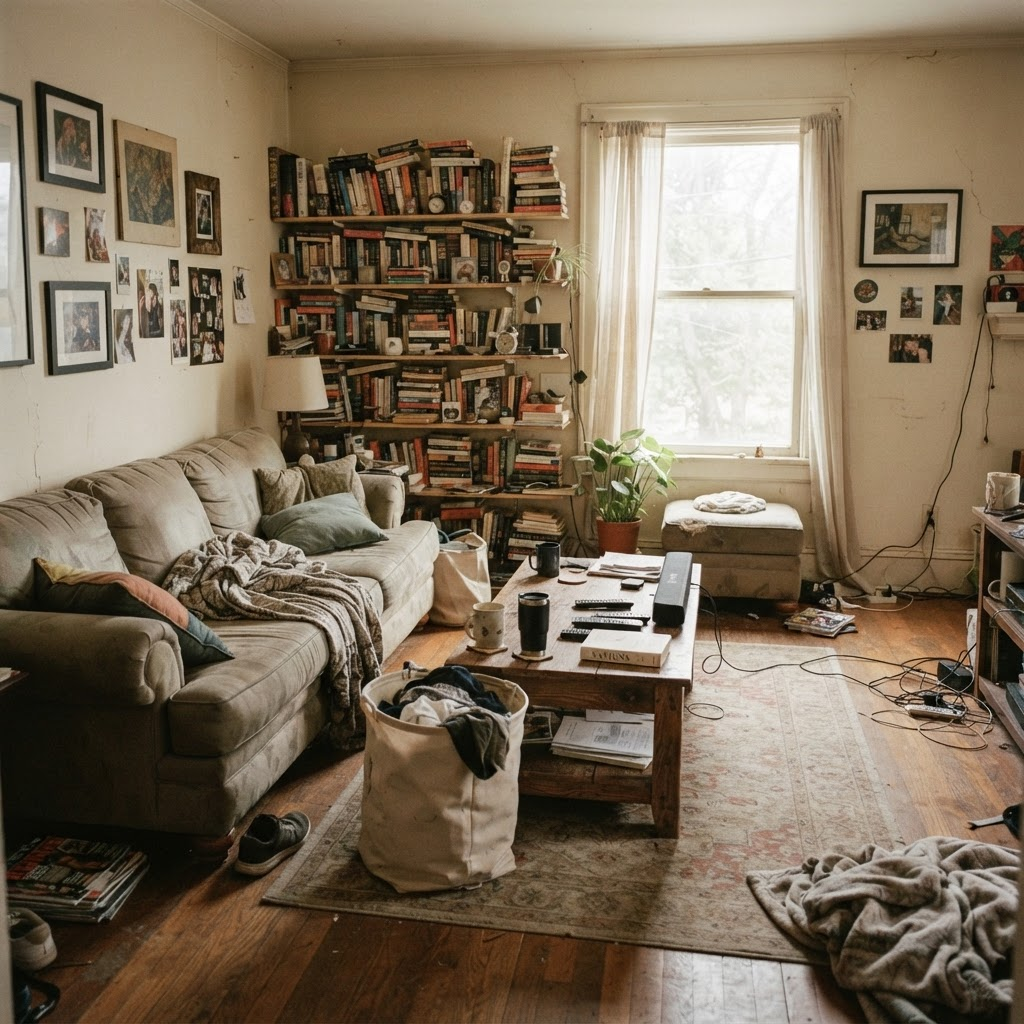
What in-home capture needs
A laundry cycle crosses a hamper, a hallway, a machine and a folding surface. The spec names the full arc and the rooms it passes through, not one isolated grasp.
Clothing, bedding and bags do not track well with propagated masks, so household episodes ship per-frame instance masks for them.
Capture happens inside lived-in spaces. Every episode links to a signed release, bystanders are de-identified or the footage is discarded, and bathroom capture excludes any other person in frame.
Hardware sync, twice-per-session calibration and a reject log apply in a home exactly as they do elsewhere, and rejected items are recaptured at our cost.
Definition
In-home egocentric data collection means recording first-person video inside real homes, from a viewpoint close to what a household robot’s own camera would see. A paid contributor wears a capture rig and performs a household task from a written skill spec. The footage is checked, anonymized, labeled and delivered to your training stack.
It is human capture. A person wearing the rig does the task, so the data is first-person human video of home tasks rather than robot trajectories logged in a home. A person can move through many homes without the safety and access problems of taking an early-stage robot through someone’s kitchen or bathroom.
Why real homes
A household robot deployed at scale will work in homes it never saw during training: different layouts, furniture, clutter and people. A model trained on a staged set or a single house learns that set or that house.
NVIDIA’s GR00T N1 paper describes a data pyramid with web data and human video at the base, synthetic data in the middle and real robot trajectories at the top. First-person human video of home tasks sits in that base layer. Human capture is the practical way to cover many homes because it does not need a robot on hand in every home visited.
Diversity matters as much as hours. Generalist’s GEN-0 write-up states that data quality and diversity matters more than sheer volume. A corpus that repeats one living room many times covers less than the same hours across many homes, which is why the spec names room types rather than leaving coverage to chance.
Tasks
The household tasks this site already documents are laundry, tidying, cleaning and surface reset, across whole homes. They are long-horizon, low-precision and navigation-heavy, which is why they differ from tabletop manipulation. The first table lists the six stated task categories and what each one exercises.
The same categories span several room types: living space, bedroom, bathroom, utility room, and stairs and hallway. Kitchens are covered separately on this site, where the kitchen dataset describes two-handed food prep in real homes. The second table lists each setting and how the spec treats it.
The scope stays household chores; anything not stated here is set per program in the skill spec.
Skill spec
We design the first draft of the spec with you on a call. For in-home work it names the task list, the room types the corpus must span, the participant and lighting mix, the capture tier, annotation depth and the accept criteria.
Room types should be named explicitly, because a laundry cycle or a cleaning routine crosses rooms rather than staying in one cell. Coverage targets can be set per axis (contributor, scene, task, object, condition and failure case) and tracked per batch, as described on the diversity page.
How many homes, rooms or contributors a program covers is set per program in the skill spec, and the quote states reach, timeline and price before any capture begins.
Capture setup
The instrumented tier is a head-mounted stereo rig. It records first-person RGB, with a metric depth stream recovered from the calibrated stereo rig rather than a standalone depth sensor, and 6-DoF IMU data at 200 Hz from head- and wrist-mounted sensors. The wider capture stack is ten streams: a 4K head camera, two wrist cameras, depth, IMU, 3D hand and body pose, instance segmentation and action labels, hardware-aligned under 2 ms.
Every session is calibrated twice, before capture starts and after it ends. The solve uses a checkerboard target across 40 poses, per-camera intrinsics to a reprojection error under 0.28 pixels, and head, wrist and depth extrinsics against the shared target. The drift between the two solves is written into the episode metadata.
Labels follow the delivered episode schema: hand_joints with hand_visible flags, body_joints, contact_events, instance_masks, objects, action_segments and gaze_target. Which of these a program attaches is set in the skill spec. The third table maps each part of the setup to where it is recorded. The rig is worn by the contributor; no robot or teleoperation capture is part of this page.
Consent and privacy
Household capture happens inside lived-in spaces, which raises the bar above a lab or workshop. Every contributor signs a written release before capture, and each delivered episode links to that record through consent artefact IDs in the batch data card. The consent chain has six checkpoints, from before capture to after delivery, and a break at any one discards the footage rather than shipping it at a lower grade.
At ingest, automated detection finds faces, plates and screens and blurs them, and speech is scrubbed of names, addresses and card numbers while ambient audio is kept. A human reviewer confirms that no un-consented person is identifiable in any frame. If a person cannot be de-identified, the footage is discarded.
Bathrooms get a stricter rule: capture excludes any episode with a person in frame other than the consenting operator. Site permission is kept on file where the site needs it, and the exact permission detail for your homes is set per program in the skill spec. The provenance page publishes the release and the anonymization page describes the full pass. None of this is legal advice, and the executed agreement controls.
Validation
Validation runs against signed accept criteria written into the spec before capture. A reject log ships with every batch. An episode is accepted only if RMS reprojection stays under 0.28 px and the drift is within tolerance; otherwise it goes to the reject log, visible to you.
At ingest, episodes are machine-checked against the reject criteria in the fourth table, and a human reviewer then checks each episode against the task spec. Rejected items are recaptured at our cost rather than shipped with a caveat.
Most orders start with a Spec Pilot, a small first batch that proves the spec and accept criteria on real footage before volume scales.
Comparison
Public datasets are captured for someone else’s task distribution. The fifth table compares Egocentric-10K, whose official card states the footage is collected exclusively in real factories, attribute by attribute; where the card does not state something, the table says so.
The structural difference is control over the setting: a custom in-home collection is scoped to the room types and tasks your model is missing. A public release can still suit exploration or a baseline. Whatever you use, check its license and consent terms.
Delivery and license
Delivery is in the format your training stack reads: RLDS, LeRobot and WebDataset, plus HDF5, zarr and Rerun .rrd. Converter source is readable, so you can retarget the schema to your own loader. The HDF5 layout, including the stream names, is on the custom HDF5 page and the episode schema page.
The license is perpetual, irrevocable and worldwide, with the data buyer-owned and non-exclusive by default. Training, evaluating, fine-tuning and deploying models, including commercial ones, is permitted. Exclusivity is available per skill line or per environment as a separate term, and the executed agreement controls.
Getting started
Describe the rooms, home layouts or tasks your model is missing. That becomes a written spec, quoted for reach, timeline and price before any capture begins. Many programs start with a Spec Pilot.
Where coverage for your tasks and regions is deep, the median time from signed spec to first validated batch is a median of 48 hours; where it is thin, three to four weeks while recruiting expands. Anything this page does not state, such as home or contributor counts, is set per program in the skill spec.
At a glance
Every collection runs through the same seven-stage end-to-end custom collection pipeline. End-to-end custom data collection is a managed service that takes an AI data need from problem to owned dataset in a single accountable pipeline.
Tasks
| Task | What it exercises | How it is specified |
|---|---|---|
| Fold and sort laundry | Deformable-object handling, bimanual coordination | Named in the skill spec with its task boundaries |
| Load, transfer and unload a washer | Long-horizon sequencing across two locations | Named in the skill spec with the rooms it crosses |
| Surface wipe and clutter reset | Object recognition amid visual clutter | Named in the skill spec with object classes |
| Vacuum with obstacle negotiation | Whole-room navigation, dynamic obstacle avoidance | Named in the skill spec with the room types |
| Bed-making, bimanual sheet handling | Large deformable objects, two-handed coordination | Named in the skill spec |
| Bin change and bag tie | Fine manipulation combined with navigation | Named in the skill spec |
Settings
| Setting | How the site states it | How the spec handles it |
|---|---|---|
| Living space | Listed among the household environments | Named in the spec; how many are covered is set per program |
| Bedroom | Listed among the household environments | Named in the spec; how many are covered is set per program |
| Bathroom | Listed; episodes with any person in frame other than the consenting operator are excluded | The exclusion applies to every bathroom episode |
| Utility room | Listed among the household environments | Named in the spec; how many are covered is set per program |
| Stairs and hallway | Listed among the household environments | Named in the spec with the navigation tasks done there |
| Kitchen | Described on the kitchen dataset page as two-handed food prep in real homes | Specced separately; see the kitchen pretraining page |
Capture setup
| Part | As stated on this site | Where it is recorded |
|---|---|---|
| Head-mounted stereo rig | First-person RGB from a head-mounted stereo rig | Camera streams in the episode |
| Depth | Metric depth recovered from the calibrated stereo rig, not a standalone sensor | streams/depth_mm and streams/depth_conf |
| IMU | 6-DoF at 200 Hz from head- and wrist-mounted sensors | streams/imu_head, imu_wrist_l, imu_wrist_r |
| Hand and body pose | 3D hand and body pose with visibility flags | annotations: hand_joints, hand_visible, body_joints |
| Task structure | Action segments with labelled task boundaries; contact events | annotations: action_segments, contact_events |
| Deformable objects | Per-frame instance masks | annotations: instance_masks, objects |
| Sync | Hardware-triggered off one clock; 2.0 ms ceiling | Reject flags in the episode metadata |
| Calibration | Twice per session; reprojection under 0.28 px | calibration/rms_reproj_px and calib_drift_mm |
Acceptance
| Reject criterion | What it protects | Outcome |
|---|---|---|
| Sync breach beyond the ceiling for more than three consecutive frames | Alignment of video, depth, IMU and pose | Reject log; recaptured at our cost |
| Calibration drift beyond tolerance between opening and closing solves | Geometry between head, wrist and depth | Reject log; recaptured at our cost |
| Manipulated object out of frame for more than 15 percent of the episode | Task visibility | Reject log; recaptured at our cost |
| More than 35 percent invalid depth pixels in the manipulation region | Depth usability | Reject log; recaptured at our cost |
| An undocumented bystander | Consent and privacy | Footage discarded or held |
| A mismatch against the named skill spec | The task you ordered | Reject log; recaptured at our cost |
Comparison
| Attribute | Egocentric-10K (official dataset card) | In-home custom collection (this site) |
|---|---|---|
| Setting | Collected exclusively in real factories | Real homes, room types named in the skill spec |
| Household tasks | Not stated on the card | Laundry, tidying, cleaning and surface reset, as specced |
| Who sets the scope | Its authors; assess from the card | You, in the skill spec |
| Consent record per file | Not stated on the card | Consent artefact IDs per episode in the batch data card |
| Anonymization record | Not stated on the card | Detector version, pass timestamp and reviewer confirmation per episode |
| License | Apache 2.0 | Perpetual, irrevocable, buyer-owned, non-exclusive by default |
FAQ
Sources
Tell us which rooms, home layouts and household tasks your model is missing. We write them into a spec, quote reach, timeline and price, and a first validated batch arrives in a median of 48 hours where coverage is deep.